


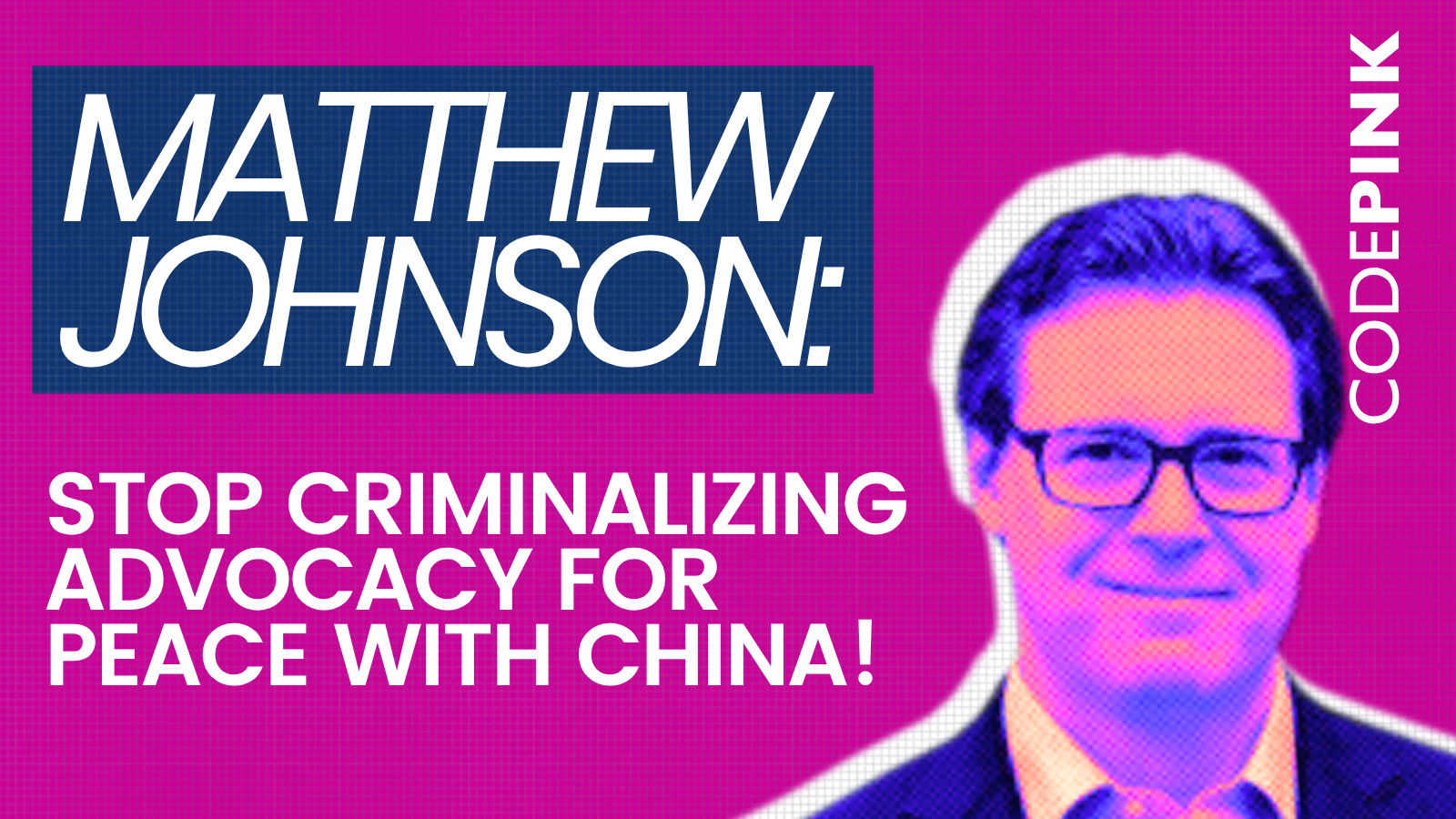
Dear Matthew Johnson,
We are writing in regards to your recent Fox News interview ahead of your congressional testimony on foreign influence and your concerns about Americans and American organizations shaping public debate in ways that you claim “align with Beijing's interests”. In light of these concerns, we invite you to consider a different question: What if Americans advocating for peace with China are not acting on behalf of the Chinese government, but doing what peace activists have always been called to do, which is to question the assumptions that make war appear inevitable and to encourage peaceful alternatives?
In your congressional testimony, you argue that a person does not need to support the Chinese Communist Party to become “useful” to Beijing, and that they need only “favor a decision useful to Beijing.” That definition is so expansive that it collapses any distinction between foreign influence and independent political thought. By that logic, an American who supports climate cooperation with China could be characterized as serving Chinese interests because China benefits. This is a deeply flawed framing. All political ideas should be evaluated according to their evidence and consequences, not according to whether another country happens to agree with them.
There is an important distinction here. If an American activist, scientist, student, journalist, or organization independently concludes that cooperation with China is preferable to war, that position does not become Chinese propaganda simply because China also benefits from peace. This is illogical; we all benefit from peace.
In fact, peace activists have a responsibility to advocate for cooperation precisely because the U.S. government is pulled toward war and militarism. Military institutions are built to prepare for threats, intelligence agencies are rewarded for targeting adversaries, and defense contractors profit from weapons procurement. Political leaders also can gain support and consolidate power by presenting a struggle between some opposing power. The role of peace activists is to reframe the zero-sum thinking that has obscured the perspectives of U.S. policymakers operating within a corrupt war economy. True security can only be built through diplomacy and cooperation, not through war and militarization.
You describe the goal of campaigns such as CODEPINK’s “China Is Not Our Enemy” as a “noble” one, while arguing that such campaigns have the strategic effect of weakening the American position, while strengthening China’s. But wanting peace with China has nothing to do with strategic goals or ambitions. It simply means recognizing that war is not the answer, and that differences can and must be solved through diplomacy and open dialogue. We believe this is in the interests of both the U.S. and China, as well as the entire world.
The consequences of war between the U.S. and China would be unlike anything seen in history. In the past 60 years, the nature of warfare has changed dramatically, and civilians increasingly bear the consequences. In World War I, civilian deaths were a relatively small share of total deaths, but in conflicts since then, civilians have borne an enormous share of the human cost.
The wars of the post-9/11 era demonstrate what this means in practice. Research from Brown University’s Costs of War project estimates that more than 940,000 people were killed directly by post-9/11 wars through 2023, including more than 432,000 civilians. When deaths caused indirectly by the destruction of healthcare systems, infrastructure, economies, food supplies, and the environment are included, the estimated death toll rises to at least 4.5–4.7 million. More than 38 million people have been displaced. These numbers are a reminder that war has reverberating consequences for generations to come because it also destroys the conditions that allow ordinary people to live.
War between the United States and China would be vastly more destructive. It would involve two of the world's largest military powers, both possessing nuclear weapons, and would take place in and around one of the world's most densely militarized and populated regions. Japan, South Korea, the Philippines, and communities throughout the Pacific would bear much of the human cost.
Additionally, the United States and China are deeply interconnected economically and scientifically. A major war could disrupt global trade, food and energy supplies, manufacturing, financial markets, scientific cooperation, and international efforts to address climate change. This would have vast, devastating consequences for people all around the world.
A war between the United States and China also carries the terrifying possibility of nuclear escalation. Both countries possess nuclear weapons, and a conventional conflict between two nuclear-armed powers creates escalation risks that we must avoid at all costs.
This is why advocating against war cannot be brushed off as “accommodation to Beijing”. The responsibility of U.S. policymakers should be to reduce the conditions that could produce escalation, not continually expand them. Every new military deployment, weapons system, alliance commitment, or piece of legislation framed around preparing for a confrontation with China should therefore be considered in terms of whether it makes war more or less likely, and what the consequences would ultimately be.
You also argue that a world in which the United States plays a “lesser role” is inherently contrary to American interests. This could not be more false. It is in American interests to have access to housing, healthcare, education, safety and security. Instead of pouring all our resources into war, we should choose to invest them in the things that actually make communities safer and more secure. This is what we mean when we call for a different vision of security. Americans are not made safer by endless militarism. Genuine security means people having homes, healthcare, education, clean air and water, and economic stability.
And yet, the U.S. continues to pour extraordinary resources into war. The administration has requested $1.5 trillion for national defense in FY2027, the largest annual military budget in history, with a good deal of it justified as being needed to prepare for war against China. Brown University’s Costs of War project estimates that the United States has spent approximately $260 billion every year since 2012 on countering China militarily, following the Obama administration’s “pivot to Asia.” This is excessive and unsustainable military spending that comes at a profound cost. Every dollar spent on war is a dollar that cannot be invested in the needs of ordinary people.
A multipolar world is also in the interests of all people. The United States maintains hundreds of military bases and installations around the world, deploys troops across other countries and regions, and has repeatedly used military intervention and economic pressure, often at the expense of civilian populations. The U.S.-dominated international order has historically treated other nations as lesser, treating their security, sovereignty, and development as subordinate. A multipolar world would allow countries to determine their own futures and pursue their own political and economic systems, for the wellbeing of all peoples.
You ask whether Americans are leading the debate or whether Beijing is. That is the wrong binary. Americans should lead the debate and be free to conclude that peace is in their own interest. We should be able to advocate diplomacy with China because we believe in diplomacy. We should be able to oppose a new Cold War because we oppose Cold Wars. We should be able to criticize military expansion because we believe resources should be directed toward human needs. And we should be able to say that China is not our enemy because we believe creating enemies is a dangerous way to organize the world.
That is precisely why engagement with China matters. Your testimony calls for greater China expertise, and we agree that Americans need a deeper understanding of China. But genuine expertise does not mean understanding China only through the U.S. zero-sum national security framework that is inherently geared toward competition and war. It requires studying China’s history, political system, culture, society, development, and foreign policy, including perspectives that challenge the assumptions dominant in Washington.
There is also a deeper lesson from the history of peace movements. Many of the positions that policymakers attempt to criminalize before a war are precisely the positions that are necessary to prevent one. Our role is to challenge the push to war and question narratives that portray another nation as an inevitable enemy.
You have raised concerns about transparency and foreign influence. It is true that transparency matters, but transparency should apply equally to the forces pushing for war. We should also ask who benefits from the enormous expansion of U.S. military spending, who funds the institutions advocating against China, what interests shape threat assessments, and how frequently military solutions are presented before diplomatic ones.
We hope you will consider engaging with peace activists not as potential conduits for foreign influence, but as Americans participating in our right to question our government's militant foreign policy and organize for a better future. We urge you to stop criminalizing advocates speaking out against the U.S. escalating war drive against China. It is only these voices that can prevent a war before it is too late.
For peace and truth,