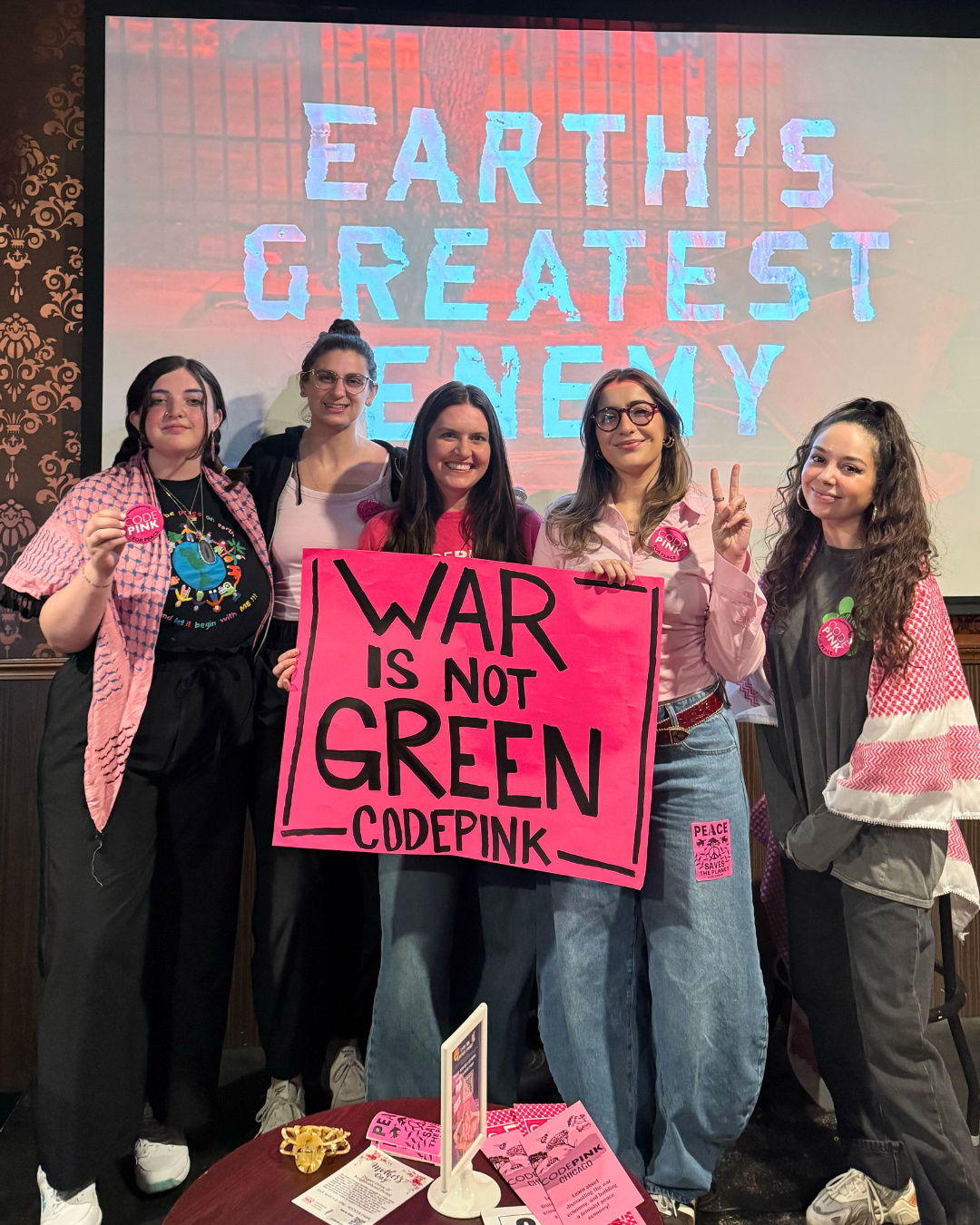
Just two days ago on Earth Day, a number of CODEPINK chapters hosted screenings and discussions of Earth’s Greatest Enemy, directed by Abby Martin and Mike Prysner. The film explores the environmental impact that the U.S. military has on the planet. Our chapters educated audiences across the country and recruited hundreds of new people into our movement. It wasn’t just a movie night, it was an opportunity to make sure the movement isn’t losing steam, because we have a big, new fight ahead of us that I need to tell you about.
What’s Emerging:
Our chapters in the Midwest have been discussing the rising threat of AI data centers in their local communities. As an anti-war organization, we are struggling against data centers as both products of and products for war. They are poisoning local ecosystems, driving up utility costs, and creating deadly long-term health risks. There’s national momentum on this — almost half of this year's planned data center projects have been delayed or canceled due to local organizing.
👉Sign up to be in the loop about our work on data centers and the war economy.
AI data centers are rapidly expanding around the country because they are the newest source of profit for companies like Amazon, OpenAI, Palantir, and Meta. They are emerging around the Great Lakes specifically, due to the immense need for water to cool their processors. Meanwhile, a planned center in Louisiana is projected to consume as much water as the entire city of New Orleans. Utility costs are skyrocketing, and the noise and air pollution from these centers will cause asthma and long-term health impacts for the communities that are stuck with them. While data centers are a new issue, they come from an old source: the same institutions that created the toxic waste grounds of Camp Lejeune in North Carolina and the 800+ military bases around the world.
What we’re building towards:
Our work to confront these de facto privatized military installations, as with all parts of our War Is Not Green campaign, seeks to bring together what may seem like isolated issues in a time of chaos — U.S. invasion of Venezuela, the bombing of Iran and Lebanon, ICE in our streets, an increasing affordability crisis — in order for people to understand a single planetary threat: the endless extraction and resource accumulation enforced by U.S. militarism and imperialism. Data centers are not something that should stretch us even thinner, but rather something we can organize against as the physical manifestation of the war economy in our backyards. We have the proximity and power to disrupt and confront them, and that’s why our chapters are galvanized.
👉Learn more about our data center strategy!
How you can get involved:
Local and national struggles against data centers can serve as spaces to build a more unified movement. Highlighting them and the wars that benefit from them can give us concrete fights and wins, advancing our collective ability to live. We can make these connections abundantly clear in conversations with environmental organizations to build a larger, more powerful coalition. We can bring anti-war organizations into local environmental-led fights against data centers. We can talk to farmers losing their land and water, and we can talk to the parents in cities living paycheck to paycheck, while their utility prices rise exponentially and whose children can’t fall asleep because of the constant humming of data centers.

👉Check out videos making these connections from our Midwest data center organizing!
Why we are part of a singular struggle:
At the end of 2025, I reflected on COP30, the U.N. climate conference, and the parallel Peoples’ Summit in another email to many of you. I was struck by the closing statement of the Peoples’ Summit’s Final Declaration:
“...We believe that it is time to unite our forces and face our common enemy…Let us root our internationalism in each territory and make each territory a trench in the international struggle. It is time to move forward in a more organized, independent and unified way, to increase our awareness, strength and combativeness. This is the way to resist and win.”
We heard something similar from Isabella Guinigundo from the Youth Climate Finance Alliance in our webinar at the start of Earth Month:
“We don’t simply see a connection between U.S. militarism and ecological destruction. Rather, to correctly tackle one or the other would require us to understand that frontline fights against ammonia plants and liquified natural gas refineries in Texas and Louisiana, that flotillas to Cuba and to Gaza, and the campaigns to disrupt the weaponry and supply chains of U.S. militarism, these are all fronts in one unitary struggle against U.S.-led fossil fuel-ed imperialism. To tackle one of those fights is to take part in that singular struggle.”
This is increasingly clear for the climate movement, who have taken on slogans like “No Blood for Oil,” participated in delivering solar panels to Cuba to support their energy sovereignty, and are about to go to Santa Marta, Colombia, with representatives of over 50 countries for the first-ever International Conference for the Phase Out of Fossil Fuels, where we have worked to make militarism a central issue. We are making it clear that we are fighting a singular struggle. Whether that be at Earth’s Greatest Enemy screenings, where no one has left without a flyer full of action steps, through emerging local and national work on data centers, and through our outreach to environmental organizations with their own networks and resources. We are making the movement stronger and impossible to look away from. We can be coordinated and clear-eyed — and move forward accordingly as a mass movement.
👉I look forward to connecting with you at one of our working group meetings.
Until Liberation,
Aaron, Jodie, and the entire CODEPINK team
P.S. Check out our Earth Month page to find some resources on how to bring militarism to environmental organizations, and learn more about our ongoing work!
 CODEPINK Detroit hosts a screening of Earth's Greatest Enemy on Earth Day.