By Medea Benjamin
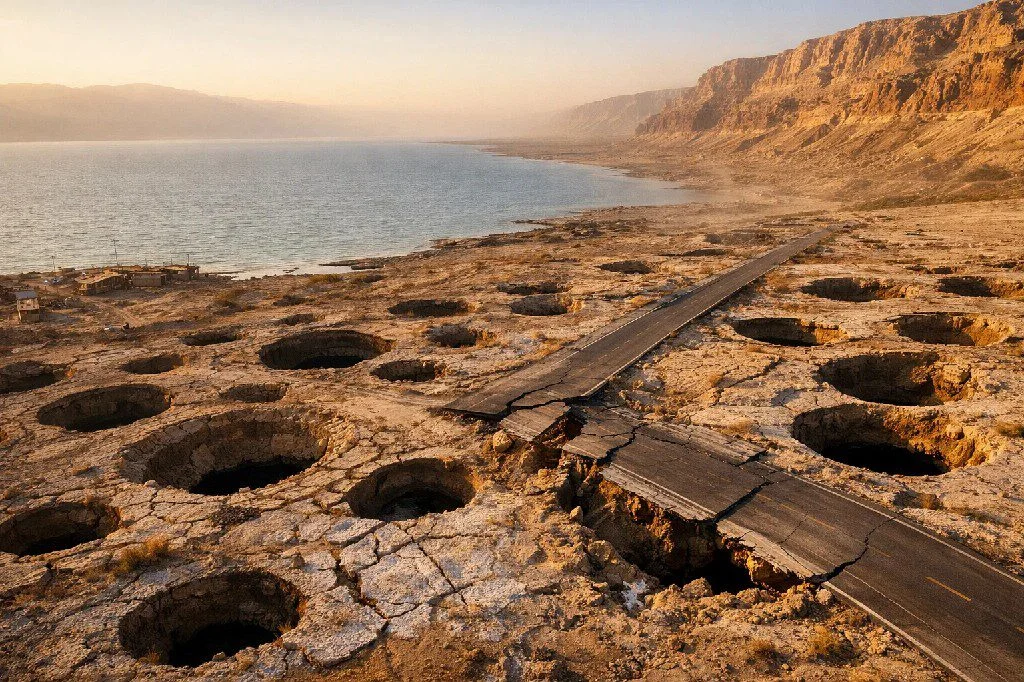
Since the 1980s, more than 6,000 sinkholes have formed along the Dead Sea coast, appearing at a rate exceeding 400 per year.
Walk into the personal care aisle at Whole Foods and you can find a spa-style five-pound bucket of Dead Sea Warehouse’s “Amazing Minerals” bath salts for $33.49. Whole Foods also sells Dead Sea salts under its own 365 brand for a bit less. Both are labeled “Made in Israel.”
The advertising from Dead Sea Warehouse tells customers that “the magic is in the minerals,” boasting that its salts contain more than 21 therapeutic minerals. It urges shoppers not merely to soak, but to “saturate,” and promotes the salts as detoxifying, moisturizing, exfoliating and soothing.
But behind that upscale wellness pitch is a much uglier story: the exclusion of Palestinians from the natural resources on their own land and the environmental destruction of one of the world’s most extraordinary bodies of water.
The Dead Sea runs along the occupied West Bank, yet Palestinians have been shut out of developing its shoreline or benefiting from its immensely valuable mineral resources. Checkpoints, military closures and restrictions on Palestinian development reinforce that system of exclusion.
The World Bank has documented this extraordinary disparity. Much of the Palestinian Dead Sea shoreline lies in Area C of the occupied West Bank, where Israel retains control over planning and development. Palestinian investors have been unable to obtain permits for Dead Sea tourism projects, including hotels and recreational facilities. The World Bank has estimated that access to Dead Sea resources could have generated close to a billion dollars a year for the Palestinian economy.
Human Rights Watch has put the situation even more starkly: Israel has denied Palestinians permits to extract valuable Dead Sea minerals such as potash and bromine while allowing Israeli companies to exploit Dead Sea resources commercially for decades.
So when we see a product labeled “Dead Sea Salt — Made in Israel,” we should ask: Who gets to extract and profit from these resources? And who is prevented from doing so?
There is another tragedy hidden behind the soothing language on these containers: the Dead Sea itself is dying.
I have personally watched it happen over more than half a century.
In 1970, I lived at Kibbutz Ein Gedi, right on the Dead Sea. Back then, the sea was part of everyday life. We would head down to the water to float effortlessly in its famously salty waters. Because the water contains such a high concentration of dissolved salts and minerals, it is much denser than ordinary seawater and gives the human body extraordinary buoyancy. We even went water skiing there—it was probably the easiest place in the world to get up on skis. There was a bustling beach and tourist area right along the shore.
Today, the landscape is almost unrecognizable.
The old Ein Gedi beach and tourist facilities are abandoned. The shoreline has retreated dramatically. Places that once sat beside the water are now stranded far inland. Roads have been closed or swallowed by the unstable ground, and the landscape is pockmarked with enormous sinkholes. There are now roughly 6,000 sinkholes along the shore.
The Dead Sea has been dropping by roughly a meter a year for decades. The largest cause is the diversion of the Jordan River and other freshwater sources before they reach the Dead Sea. Israel, Jordan and Syria have all diverted water from the watershed.
But commercial mineral extraction is also part of the disaster. Industrial operators pump enormous quantities of Dead Sea water into evaporation ponds, where the water evaporates and minerals are harvested. This process contributes to the loss of water from an already rapidly shrinking sea.
Dead Sea Warehouse contributes to this ecological disaster by marketing Israeli Dead Sea minerals to consumers around the world. Whole Foods participates in that commercial economy not only by stocking Dead Sea Warehouse products but by putting its own 365 brand on these “Made in Israel” salts.
There is something deeply perverse about marketing the “rejuvenating” properties of a sea that is itself being drained of life.
A customer paying $33.49 for a bucket of bath salts has no idea that behind the promises of relaxation and rejuvenation is a region where Palestinians living alongside the Dead Sea are denied access and where the ecosystem itself is collapsing before our eyes.
The “magic,” Dead Sea Warehouse tells us, “is in the minerals.” But there is nothing magical about occupation, environmental destruction or watching a unique body of water disappear.
Call Whole Foods at 844-936-8255 and urge them to take these products off its shelves.
Medea Benjamin is a cofounder of both CODEPINK and the international human rights organization Global Exchange. She is the author of 11 books, including Drone Warfare: Killing by Remote Control, Kingdom of the Unjust: Behind the U.S.-Saudi Connection, Inside Iran: The Real History and Politics of the Islamic Republic of Iran and War in Ukraine: Making Sense of a Senseless Conflict, coauthored with Nicolas J.S. Davies. Her most recent book, coauthored with David Swanson, is NATO: What You Need to Know.