By Medea Benjamin
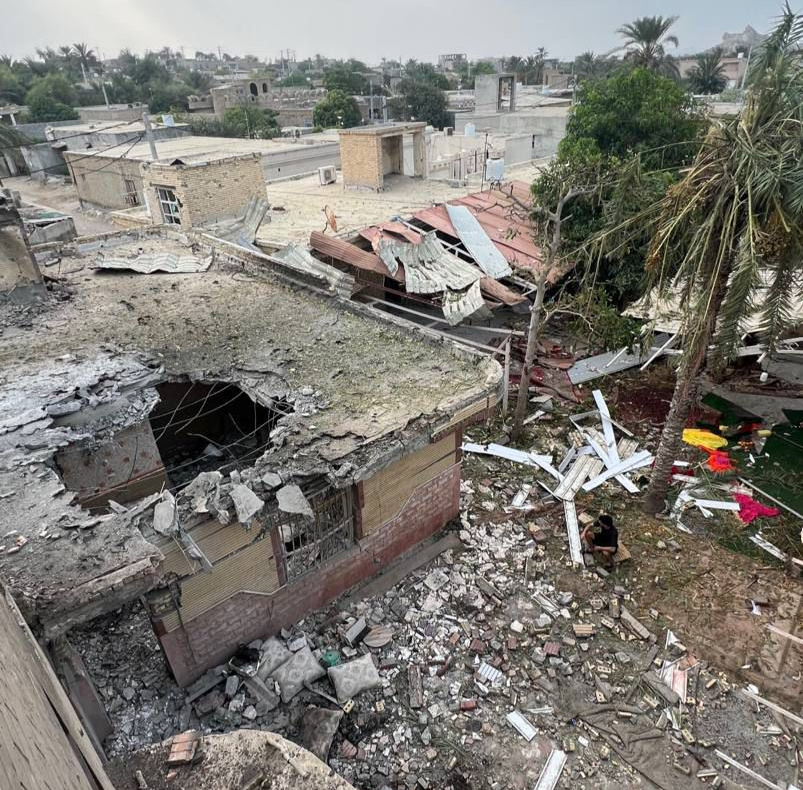
Photo: Iranian Red Crescent Society
On September 1, an American missile slammed into a home in the small Iranian fishing town of Kuhestak, along the Strait of Hormuz, where dozens of people had gathered to celebrate the wedding of a fisherman’s daughter.
At least four people were killed, including 4-year-old Amirali Karimi and 16-year-old Mohammad Mallahi. More than 60 people were wounded. Videos from the scene showed a gaping hole in the roof, concrete walls punctured, doors shattered, ceilings collapsed, and women’s and children’s shoes scattered among the debris. The bomb struck the section of the wedding set aside for women, which is why most of those injured are women and children. Iranian media showed terribly wounded children being treated at a hospital in nearby Minab, the same city where the U.S. bombed an elementary school on the first day of the war, killing 168 people, most of them children.
The Iranian Red Crescent Society has asked the International Criminal Court to investigate the U.S. strike, saying that if the wedding venue was civilian and the attack failed to respect the laws of war, it could constitute a war crime.
Questioned about the strike, U.S. Central Command spokesperson Capt. Tim Hawkins responded that: “The US military never targets civilians, unlike the IRGC.” But the US military also insists that it is using precision weapons—weapons supposedly capable of hitting exactly what the military intends to hit.
The U.S. military has yet to explain why its missile hit the wedding party. But we already know something about what went wrong in the bombing of the Minab elementary school. That strike apparently wasn't a failure of America's “precision” weaponry. It was a failure of American intelligence: CENTCOM reportedly used outdated targeting data that still treated a school—separated from an IRGC compound for roughly a decade—as a military target.
After the Minab bombing, 46 Democratic senators demanded answers from Defense Secretary Hegseth: What was the intended target? Why did the strike hit the school? Who authorized it? What weapons were used? What intelligence was used to determine what the building was? What precautions were taken to prevent civilian casualties? They gave him a March 18 deadline. He never responded. The Pentagon reportedly completed its own investigation in April, but it still has not released its findings to Congress or the American public.
Now, with a U.S. missile hitting an Iranian wedding just six months later, the same questions about targeting, intelligence and civilian protection are being asked all over again. And the tragedy in Kuhestak is part of an even longer and more disturbing pattern: the United States has repeatedly turned wedding celebrations into scenes of carnage.
In fact, American forces have bombed at least eight other wedding parties or wedding processions since 2001.
A historical review published back in 2013 by The Nation identified at least eight U.S. attacks on wedding parties or wedding processions between 2001 and 2013—six in Afghanistan, one in Iraq and one in Yemen. The estimated death toll from those eight attacks approached 300 people.
One of the most notorious attacks occurred in Afghanistan in July 2002, when U.S. aircraft attacked a wedding celebration in Uruzgan province. Afghan officials said dozens of civilians were killed. Another Afghan wedding was devastated in 2008 when an airstrike reportedly killed 47 civilians, including the bride.
The US has also hit wedding parties in Yemen. On December 12, 2013, a U.S. drone fired four Hellfire missiles at an 11-vehicle wedding procession near the city of Rad’a. At least 15 people were killed and 15 wounded. The bride herself was struck by shrapnel.
Human Rights Watch investigated the attack extensively. Witnesses described a festive convoy of 50 to 60 people accompanying the newlyweds when missiles suddenly struck the vehicles. One survivor summed up the horror simply: “We were in a wedding, but all of a sudden it became a funeral.”
At the time, CODEPINK launched a campaign to get answers, and to press the U.S. government to apologize to and compensate the victims. We even staged a mock wedding in front of the White House, dressed in wedding clothes, and reenacted a drone strike to show Americans what it meant for a joyous family celebration to suddenly become a scene of carnage.
The U.S. military insists it does not target civilians. But when a country that possesses the most sophisticated surveillance systems and precision-guided weapons on Earth repeatedly kills families at weddings and children in schools, these incidents cannot simply be dismissed as the inevitable fog of war.
If the U.S. military knew precisely what it was targeting in Kuhestak, it should tell us. Was the nearby telecommunications tower the target? Was something else nearby considered a military objective? Why was a missile fired so close to a house packed with wedding guests? What surveillance was conducted beforehand? And did commanders know civilians were gathered there?
Just as in the case of the Minab school strike, there should be an independent investigation—and the Pentagon should release whatever surveillance footage and targeting information it has.
Because after Afghanistan, Iraq, Yemen and now Iran, Americans should be asking: How many wedding parties have to be turned into funerals before we demand that our country stop killing civilians? And there is an even bigger question: Why is our military waging war, again and again, against people who never posed a threat to us in the first place?
Medea Benjamin is the cofounder of CODEPINK for Peace, and the author of several books, including Inside Iran: The Real History and Politics of the Islamic Republic of Iran.