By Medea Benjamin
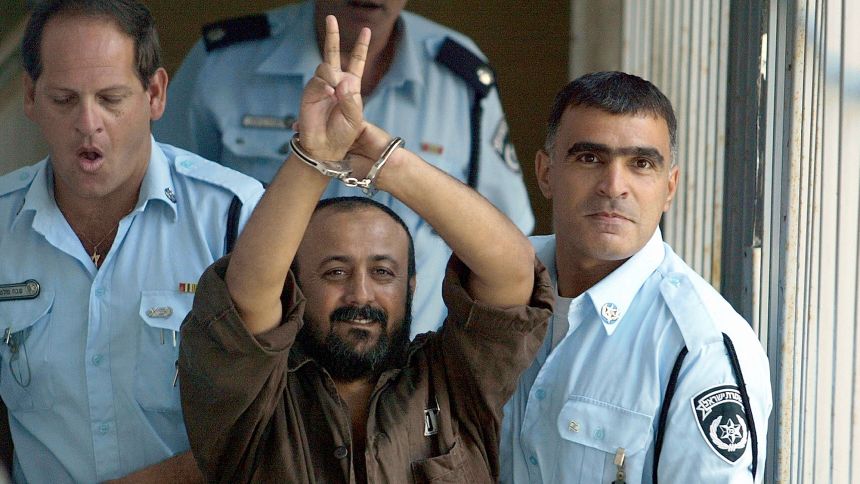
For more than two decades, Marwan Barghouti has sat behind Israeli bars—a living emblem of a brutal occupation that has denied Palestinians their freedom and dignity. His continued imprisonment is not merely unjust; it silences the one leader most capable of uniting the Palestinian people and leading them toward a political solution. Polls over many years show he is the most popular Palestinian political figure, trusted across factions and generations—even by many who have lost faith in politics. Releasing him is not a concession. It is a prerequisite for peace.
When the Second Intifada (uprising) began in 2000, Barghouti was a prominent member of Fatah, the Palestinian political faction that dominates the Palestinian Authority (PA), which governs limited parts of the occupied West Bank. He was also an elected parliamentarian. He was arrested by Israeli forces on April 15, 2002, and in 2004 an Israeli court convicted him and sentenced him to five life terms plus 40 years, accusing him of involvement in attacks that killed Israelis. Barghouti denied the charges, refused to recognize the court’s legitimacy, and declared himself a political prisoner under occupation.
Independent observers, including the Inter-Parliamentary Union, later found that the proceedings failed to meet international fair-trial standards and bore the marks of political persecution.
Barghouti’s case is inseparable from the larger machinery of occupation: like thousands of other Palestinian prisoners, he has endured brutal and degrading treatment, including torture, solitary confinement, and denial of adequate medical care. Israeli authorities are obligated under international law to ensure due process, humane treatment, and access to counsel and healthcare—obligations they routinely violate.
Throughout his imprisonment, Barghouti has set out a principled stance: he rejects attacks on civilians and defends the right of a people living under military occupation to resist within international law. He has long supported negotiations grounded in equality and self-determination. That combination makes him uniquely capable of serving as a key mediator.
It is precisely this credibility that Israel fears. As his son Arab Barghouti said, “Israel sees my father as a danger because of his ability to bring Palestinians together.” Keeping him locked away serves two aims for Israel: decapitating credible Palestinian leadership and perpetuating the fiction that “there is no partner for peace.”
His family fears for his life, with witness reports that he was severely beaten by guards in September. That fear was increased on August 15, 2025, when Israeli Minister Itamar Ben Gvir released a video in which he personally threatened Marwan inside his prison cell.
The family has repeatedly asked Israel to allow international lawyers and the International Committee of the Red Cross to visit him, but their requests have been denied.
There was hope that Barghouti would be released as part of the recent Gaza ceasefire agreement between Israel and Hamas, and Trump said he was considering pressing Israel for his release, but Israel refused.
For years, world leaders have championed his cause. In 2013, Former President Jimmy Carter, Archbishop Emeritus Desmond Tutu, and other prominent world leaders and Nobel Peace Laureates called for his release. More recently, UN Special Rapporteur Francesca Albanese said, “Anyone serious about ‘peace’ should ensure his release, as the most popular—and unlawfully detained—Palestinian leader.” Veteran anti-apartheid activist Prema Naidoo echoed the lesson of South Africa: “We have a sacred duty to campaign for the unconditional release of Marwan Barghouthi and all Palestinian political prisoners as an essential step toward the freedom of the Palestinian people.”
Even senior Israeli security figures, including a former Shin Bet director, have acknowledged that if Israel truly wants a partner who can deliver the Palestinian public to an agreement, Barghouti is the one leader with the legitimacy to do it.
This is why so many Palestinians call him their Nelson Mandela. Mandela’s release did not solve South Africa’s problems overnight, but it unlocked a door that had been nailed shut. Barghouti’s freedom could do the same.
If Israel truly seeks peace, it must stop locking away the very leadership capable of achieving it. If the international community truly stands for human rights, it must raise the political cost of Barghouti’s continued detention.
Medea Benjamin is the cofounder of CODEPINK for Peace, and the author of several books, including Inside Iran: The Real History and Politics of the Islamic Republic of Iran.