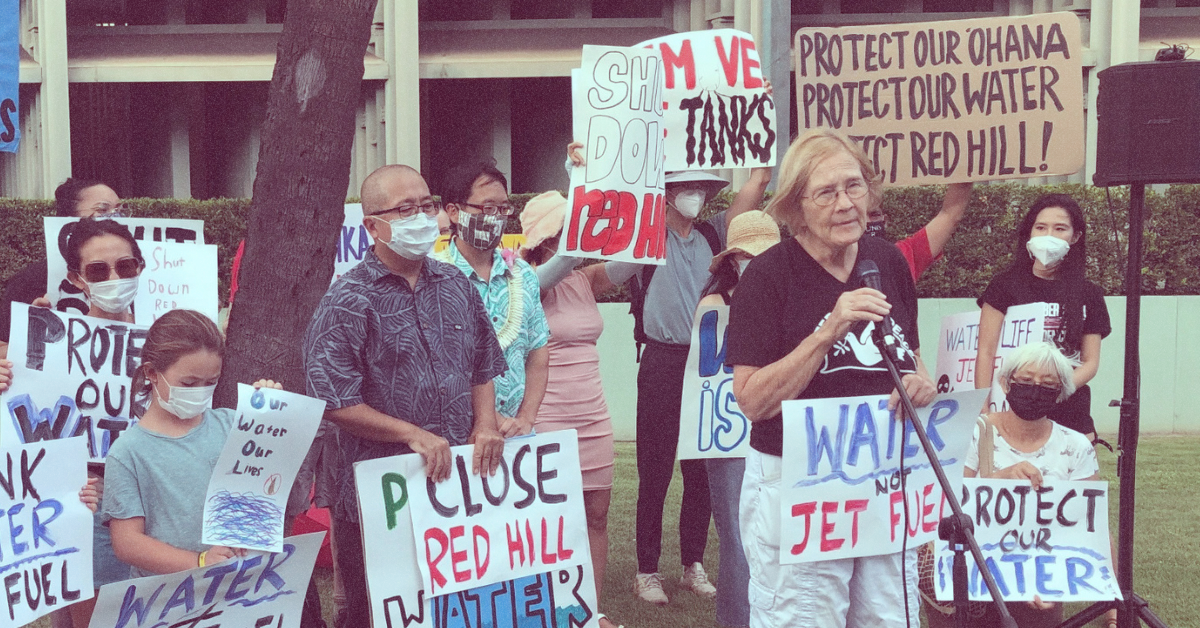
 Residents and activists protested the continued use of the Navy’s Red Hill fuel tanks in November 2021. Ann Wright is pictured at the microphone with Veterans for Peace.
A retired US Army colonel who resigned as a diplomat in protest against the Iraq war, now hosting Bike for Peace in Honolulu.
By Erik Berge, Bike For Peace
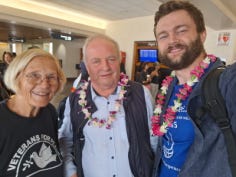
Honolulu, 29 September. When Bike for Peace landed in Hawaiʻi on Tuesday, retired Colonel Ann Wright was waiting at the airport with leis. Over dinner the same evening, Tore Nærland put her in the interview chair.
Ann Wright served as an officer in the United States Army and then for sixteen years as a diplomat in the State Department. In March 2003 she was one of three American diplomats who resigned in protest before the Iraq war began.
“I thought the pending war in Iraq was one of the stupidest things that I ever heard of. It had nothing to do with 9/11. They didn’t have weapons of mass destruction,” she said. “By that time I had already finished a military career and had sixteen years in the State Department, and I was older. And it was like, well, I don’t have to put up with this stuff. I’m just not going to be a part of that.”
From diplomat to the peace movement
The change was not easy. “I didn’t know anybody in the peace movement in the United States. I knew dissident elements in the countries where I was a US diplomat. So I knew more people around the world that were dissidents than in my own country. Soit took a while to sort out who was what.” And once she did: “Their point of view is actually pretty much what I have.”
Since then she has travelled to North Korea with Women Cross DMZ in May 2015, when thirty women from fifteen countries, among them the Nobel laureate Mairead Corrigan Maguire, met North Korean women and crossed into South Korea by bus. In November she will speak in Seoul at the International People’s Tribunal on the Korean victims of the atomic bombs. Korean survivors’ organisations estimate that around 100,000 Koreans, many of them brought to Japan as labourers, were in Hiroshima and Nagasaki in 1945, and that some 50,000 of them died. They have never been properly recognized.
She has been to Gaza around fifteen times since 2009. She sailed with the Gaza flotilla in 2010, and today she organizes the flotillas from land: raising funds, choosing participants and fitting out the boats.
Who is the inspiration?
Tore’s last question was who had inspired her. The answer was not a name. “I don’t know that there’s a specific person. I think it’s more to make up for having been in the US government was doing terrible things all over the world. I don’t think I was doing terrible things, but our government was, and I was still a part of it.”
“It’s a unique answer,” said Tore Nærland. “She doesn’t only tell what she has done, she gives the purpose of it. We need people like her in the whole world, and this is one of the reasons we have come here.”
The delegation is in Honolulu until 5 October. The pro gramme includes a meeting with Representative Tina Nakada Grandinetti at the Hawaiʻi State Capitol, the KVIBE youth bike workshop in Kalihi, the monthly vigil against nuclear weapons at the Capitol, a talk at Hawaiʻi Pacific University and a service in Kailua.
A chance meeting at Hālona
At the Hālona Blowhole lookout, where the coastal drive turned back, the delegation met a young student from China. Tore, who has cycled in China many times, asked about her studies and whether many Chinese students study where she does. They took a photograph together, exchanged email addresses so that she can receive news from Bike for Peace, and parted with Tore’s wish: “Good luck in your study.”
Bike for Peace is a Norwegian peace organisation. Tore Nærland began cycling for peace in 1976 and founded the organisation the following year. Its fiftieth-anniversary journey around the world ends at the United Nations in New York on 30 October with an appeal for a world free of nuclear weapons by 2045.