by Jenin, CODEPINK

“We have nothing to do with that.” An American Medical Association staff member said this to me with a look of disdain on her face. I was at the AMA’s annual conference in Chicago, urging the doctors in attendance to speak up for their imprisoned Palestinian colleague, pediatrician and neonatologist Dr. Hussam Abu Safiya. My group posted up outside conference rooms and handed out informational flyers uplifting his story. Dr. Abu Safiya has been held in brutal Israeli detention for over 500 days without charge; you would think these details would trigger some sympathy or at least curiosity in his American counterparts, but the opposite happened. We were flocked by security guards, verbally harassed, and treated as if we were doing something much more nefarious than handing out harmless pieces of paper.
A male security guard was threatening to get physical with me when the AMA staffer walked past — but instead of intervening, she joined in with him, egging him on. I asked her, “Do you know why we’re here, though? You guys need to speak up for your colleagues in a genocide.” She shook her head snidely, showcasing an apathy that was almost laughable considering the irony of the situation: A staff member for the country’s leading medical institution — one that prides itself on its ethics — couldn’t even pretend to care about a Palestinian doctor being tortured by Israel.
It’s quite maddening when you think of how much support the AMA gave Ukraine when the Russian invasion began. They quickly put out statements of condemnation that the healthcare sector was being impacted, and hundreds of thousands of dollars in aid were given almost instantly. It has been three years since Gaza’s healthcare sector was completely reduced to rubble, and the AMA has yet to say a single word about it. A year and a half has passed since Dr. Hussam Abu Safiya was abducted from the hospital that Israel besieged.
Coincidentally, the same week the AMA was meeting in Chicago, new photos of Dr. Abu Safiya emerged, the first in many months. He’s shown handcuffed and alone in a sterile white room, apparently on a video call with the Israeli courts.
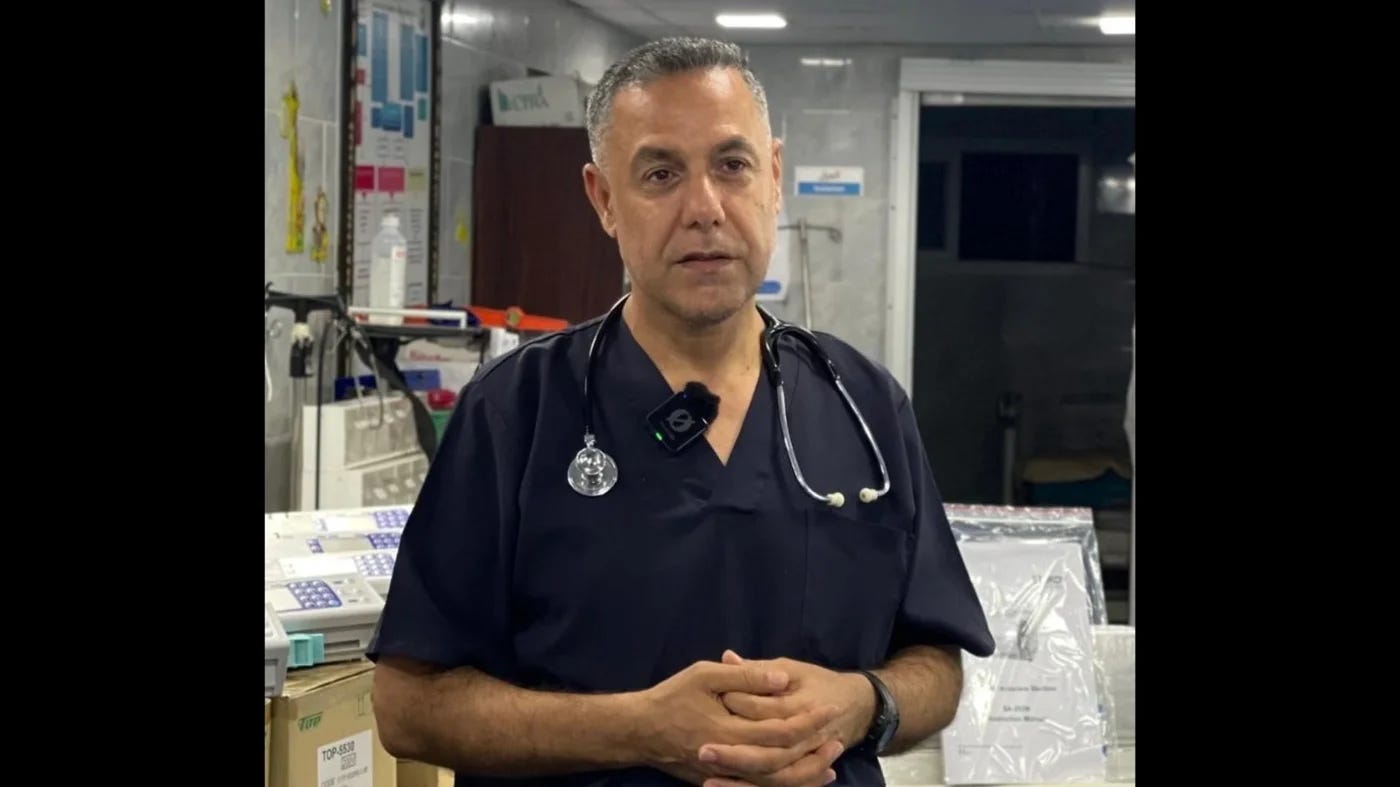 Dr. Abu Safiya before Israeli prison
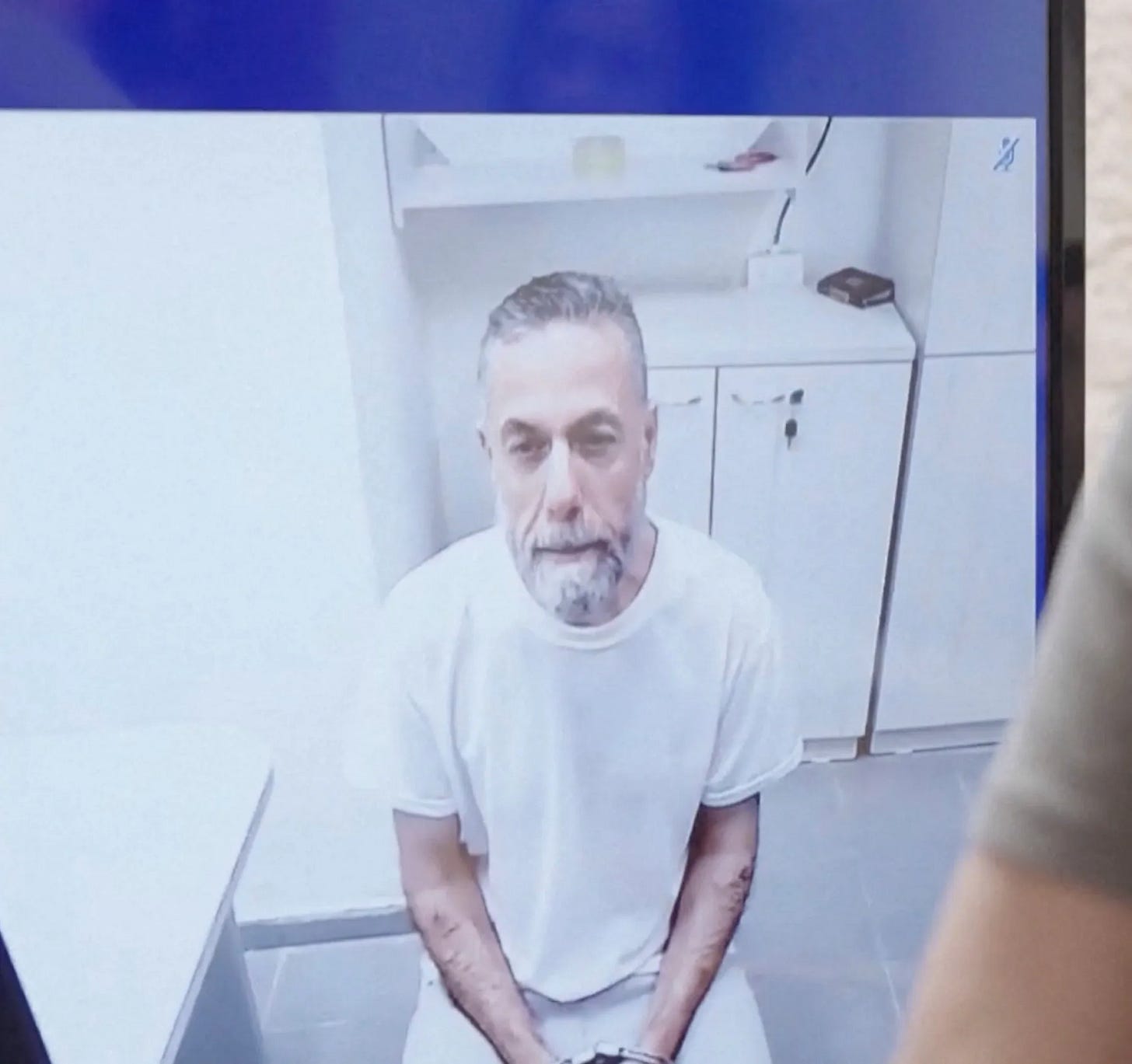 Dr. Abu Safiya after 1.5 years in Israeli prison
The new image of Dr. Abu Safiya breaks my heart. He’s lost so much weight, and there’s scarring and scabbing on his arms that weren’t there before, obvious signs of torture. Israeli prisons are vile and dangerous; they are places where military personnel can go rogue with no fear of punishment and enact their most atrocious desires. After all, these prisons are run by the likes of Ben Gvir, a racist, sadist, and war criminal. I just don’t understand how physicians in the AMA can consciously look at this photo of Dr. Abu Safiya and have nothing to say.
When Israelis are permitted to commit war crime after war crime, including holding medical professionals hostage, it sets a precedent. They’re not only killing and kidnapping healthcare workers in Gaza, but in Lebanon and Iran, too. Is it just because these are brown Muslim people that the AMA refuses to speak out? For an organization that claims a commitment to human rights and dignity, its racism is loud, and its participation in the white supremacist attitudes of Western imperialism is staggering.
This conference was a place for the AMA to discuss policy, especially around advocacy. CODEPINK staff, volunteers, and coalition partners were outside and inside the conference every single day. Our presence sparked awareness and conversation among the members, and we learned that there were debates inside on an issue the organization could no longer ignore: Palestinian healthcare workers.
Although they didn’t mention Dr. Abu Safiya by name, it’s clear that the AMA heard our collective message and that the friends of the movement inside the AMA were emboldened by our consistent energy. During the conference’s scheduled time to amend, remove, and propose new policies, a handful of resolutions were introduced about Palestine and the blatant attacks on its healthcare workers and infrastructure. There was one resolution in particular that was proof that our work was changing hearts and minds. It reads as follows:
“RESOLVED, that our AMA supports efforts to protect, release, and provide restitution to detained noncombatant healthcare workers in all areas of conflict, including Gaza.”
Ultimately, this specific resolution was not passed. But the mere inclusion and debate of the topic means that our persistence illuminated the issue of Palestine to every single person at the conference. And, because of that, the AMA delegates managed to pass 2 resolutions about the general “protection of healthcare workers and facilities in conflict areas.”
The AMA staff member and security guards knew what we were talking about; they knew the story of Dr. Hussam Abu Safiya. Whether they feel a moral obligation to do anything about it is beyond me, but we got confirmation that they knew exactly what we are organizing for. And even if the people in positions of power at the AMA don’t feel inclined to do anything about genocide, it is very clear that the general body does care.
The AMA was founded, in part, to lay out a strict code of ethics for medical professionals in the United States. These principles explicitly highlight the responsibility of physicians to advocate for human dignity, human rights, public health, and medical access for all. What has happened in Gaza over the past three years has been nothing short of an abomination of human dignity and rights. Israel and the U.S. have bombed Gaza’s public health system to the ground, and now the one million Palestinians in Gaza have been left without access to proper medical care for three years. If the AMA were run by individuals who actually practiced their own code, they would have been the first to advocate against medicide in Gaza. Unfortunately, the organization seems to favor quiet comfort over the actual embodiment of its values.
I am reminded of the photo that came out of Gaza just a few weeks after the genocide began. At a press conference outside an exhausted hospital, dead bodies of children in bags surrounded the podium, traumatized men stared at the camera, and some of the most courageous healthcare workers I have ever seen spoke out, pleading for the world to do something.
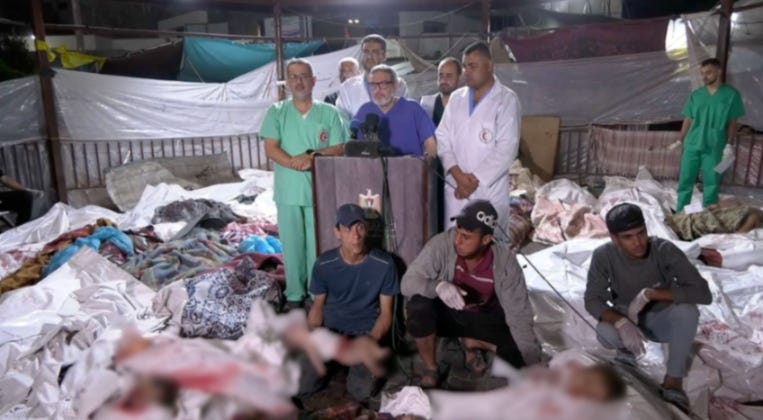
Press conference outside of Al-Ahli Hospital on October 18th, 2023.
I see the photo above, and the photo of Dr. Abu Safiya — these are just a handful of Palestinian healthcare workers making tremendous sacrifices to protect human life and dignity. They physically put themselves in the line of fire; meanwhile, the AMA doctors can’t even put out a statement. It is well past time that they break their silence. If the AMA chooses to advocate for the release of Dr. Hussam Abu Safiya, they very well might save his life.
AMA: Demand the Release of Dr. Abu Safiya!
Jenin is CODEPINK’s Palestine Campaigner
Jenin graduated with a bachelor’s degree in Public Policy from the University of Illinois at Chicago in December of 2023. For over five years, Jenin has been a community organizer and dedicated individual focused on the Palestinian movement through advocacy, digital storytelling, and grassroots mobilization. She is a firm believer in intertwined struggle and liberation for all.