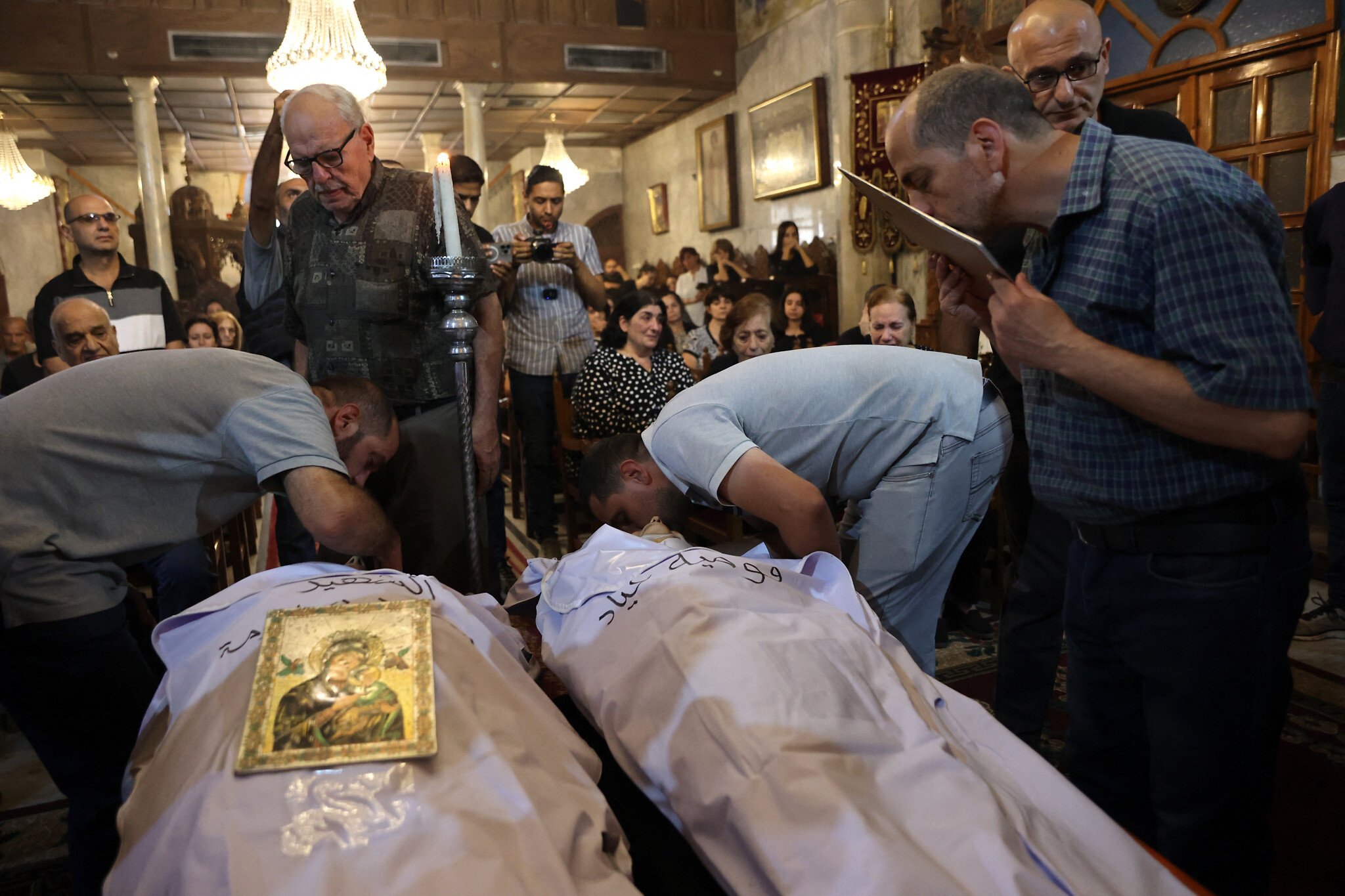
Christian Palestinian mourners bid farewell to Saad Salameh and Foumia Ayyad, killed in an Israeli strike that hit the Holy Family Church in Gaza City, during their funeral ceremony at the Saint Porphyrius Church on July 17, 2025. (Omar al-Qattaa/AFP)
By Medea Benjamin
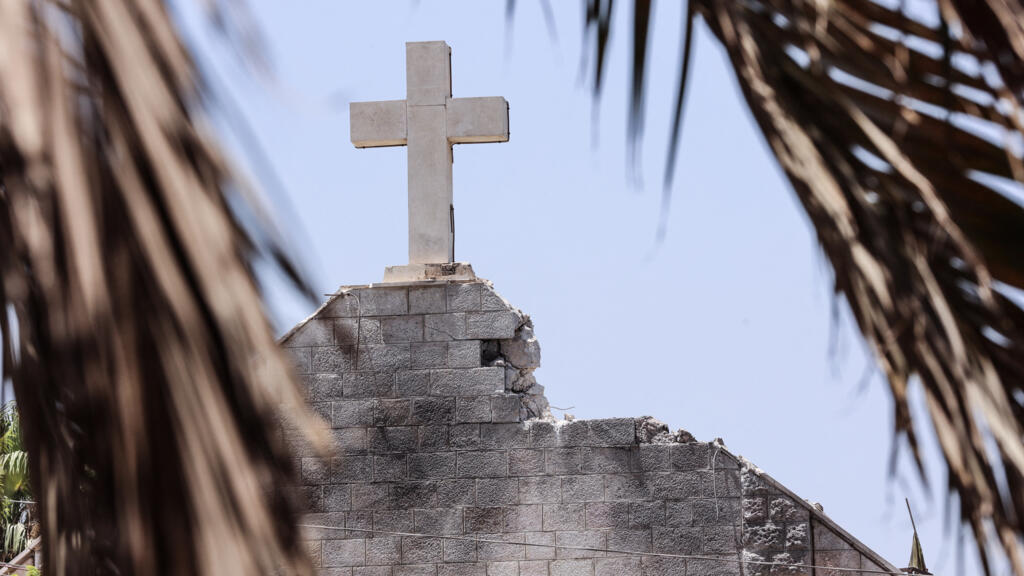
On July 17, 2025, an Israeli tank shell slammed into the Holy Family Catholic Church, Gaza’s only Catholic parish, where hundreds of displaced civilians—Christians and Muslims alike—had sought refuge. This was the same church that Pope Francis had called every evening at 7p.m., until two days before his death, offering support and prayers to the besieged community.
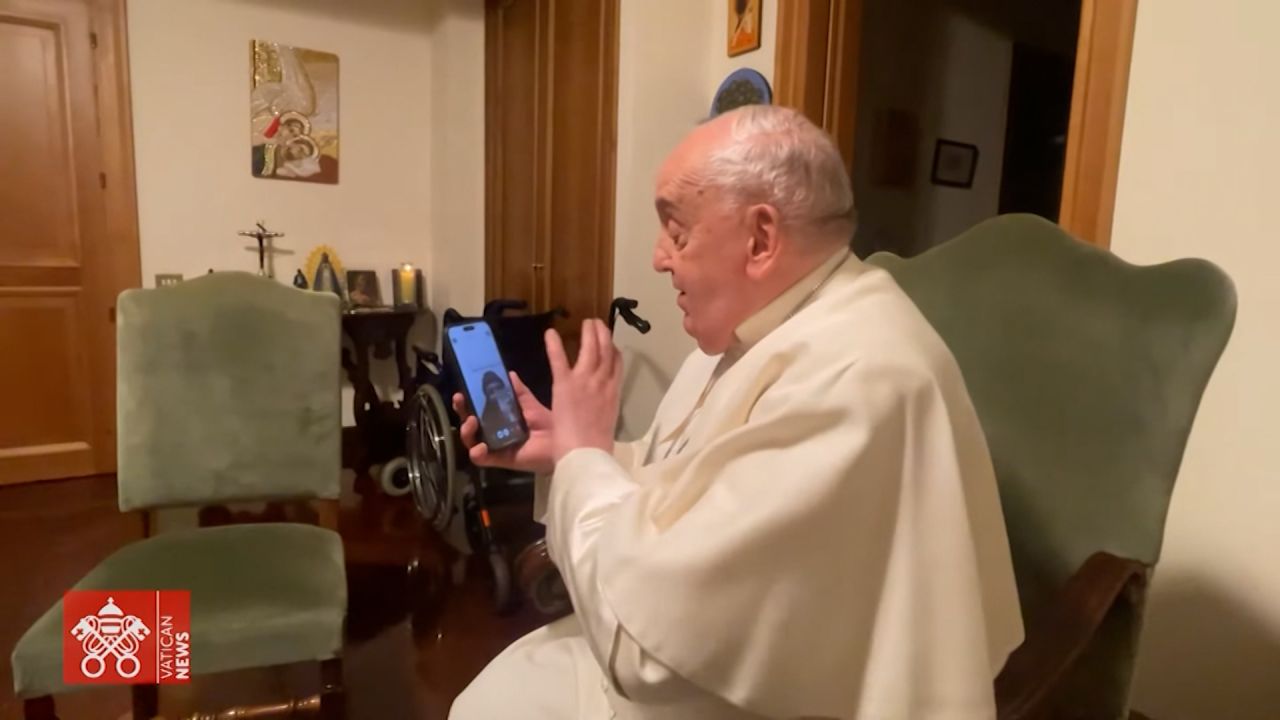
Pope Francis had a nightly ritual for the last 18 months of his life; calling Gaza’s only Catholic Church throughout the war.
The blast killed three people, wounded ten, and injured Father Gabriel Romanelli, the Argentine priest known for his nightly calls with Pope Francis. The Latin Patriarchate of Jerusalem confirmed the names of those killed: a mother Hadeel al-Masri, her 17-year-old son Fadi, and longtime church volunteer Nabil Antoun.
Despite the church’s direct ties to the Vatican, the response from Pope Leo XIV, who succeeded Pope Francis in May, was deeply disappointing to many Christians. He called the attack “unjustifiable” and “deeply saddening,” but failed to name Israel as the perpetrator. This was a far cry from Pope Francis, who said of Israel’s airstrikes in Gaza, “This is cruelty. This is not a war.”
The Israeli military has claimed the shelling of the church was a mistake, but that explanation defies credibility. There were no military targets in or near the church, which had long been publicly identified as a site of refuge. Its exterior bore the unmistakable markings of a church—the steeple, the cross, the courtyard filled with displaced families.
The attack was not an isolated incident. On October 19, 2023, an Israeli airstrike hit the Church of Saint Porphyrius, a 12th-century Greek Orthodox church in Gaza City that is considered the third oldest church in the world, killing at least 18 civilians who were sheltering inside. In the occupied West Bank, churches have been vandalized, Christian leaders harassed, and ancient Christian communities increasingly threatened by settler violence and military raids.
After the latest bombing, lawmakers such as Senator Chris Van Hollen (D-MD) expressed strong condemnation. “Deliberate or reckless attacks on places of worship where civilians are sheltering must be investigated as potential war crimes,” he said. Senator Kirsten Gillibrand (D-NY), who has been a staunch Israel supporter, called for increased international protection for religious sites, warning that attacks like the one on Holy Family “violate the very moral standards we claim to uphold.” Even former Rep. Matt Gaetz (R-FL), known for his hardline support of Israel, said in a podcast, “You can’t call yourself a moral superpower and bomb churches. And if the Pope won’t call it out, we sure as hell should.”
Reactions came as well from Christian leaders who have long stood by Israel. Reverend Johnnie Moore, a prominent U.S. evangelical pastor and former Trump faith advisor who has visited Israel numerous times, said he was “deeply grieved” by the church bombing. “I have always stood with Israel,” he said, “but this attack on a house of worship filled with civilians is indefensible. Christians around the world are watching. We must be honest about what’s happening.” Moore’s words reflect growing unease within Christian Zionist circles.
The Holy Family Church was more than a building. It was one of the few places in Gaza where Christians and Muslims broke bread together, prayed together, and shared grief and hope. The Christian population in Gaza is only about 1,000 people—less than 1 percent of the population—making the attack on one of their only sanctuaries all the more devastating.
Let’s be clear: the attacks on Muslims in Gaza, who make up 99 percent of the population, have been exponentially more devastating—tens of thousands killed and nearly 1,000 mosques destroyed. The lives of Gaza’s Christians are no more valuable than those of their Muslim neighbors. But for the millions of Christians in the United States and around the world who, for almost two years, have uncritically supported Israel’s genocide, perhaps the image of a bombed church and a wounded priest will finally pierce their conscience—and compel them to reconsider the kind of government they’ve been defending.
Medea Benjamin is the cofounder of CODEPINK for Peace, and the author of several books, including Drone Warfare: Killing by Remote Control, Kingdom of the Unjust: Behind the U.S.-Saudi Connection, Inside Iran: The Real History and Politics of the Islamic Republic of Iran and War in Ukraine: Making Sense of a Senseless Conflict, coauthored with Nicolas J.S. Davies. Her most recent book, coauthored with David Swanson, is NATO: What You Need to Know.