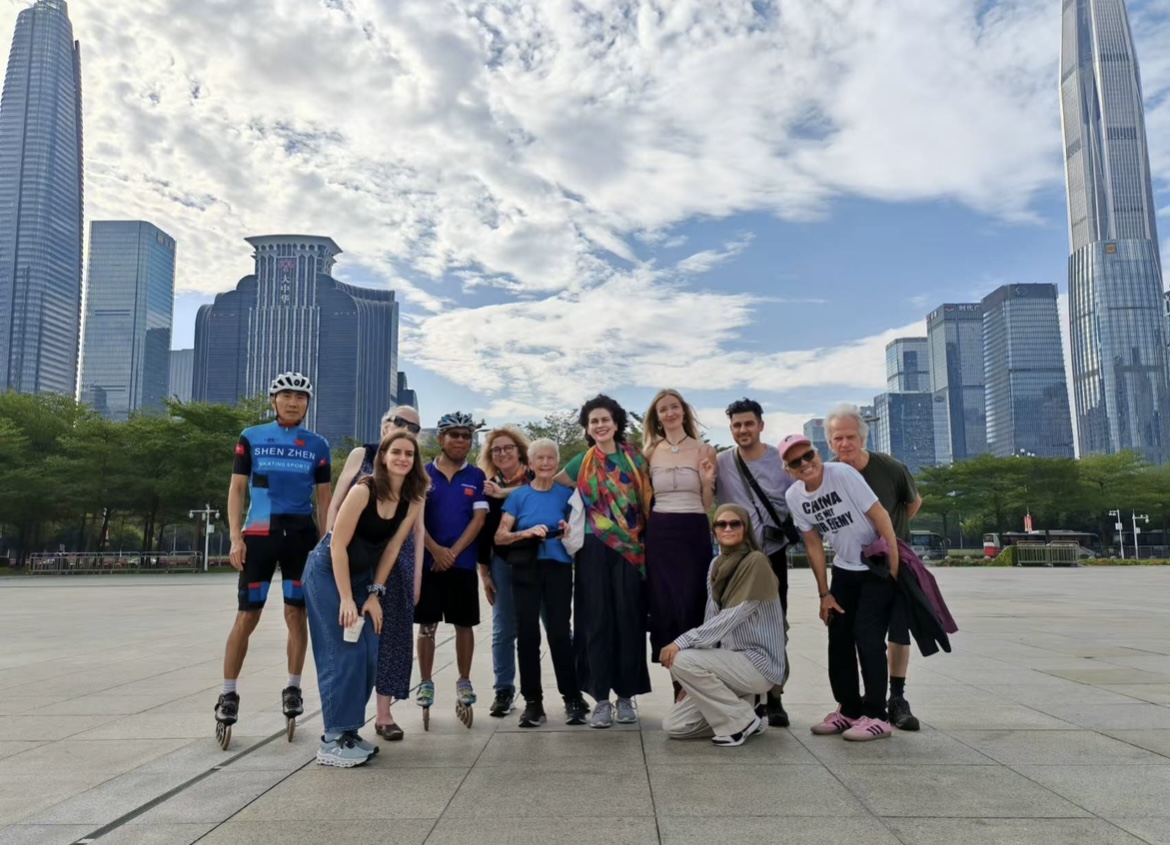
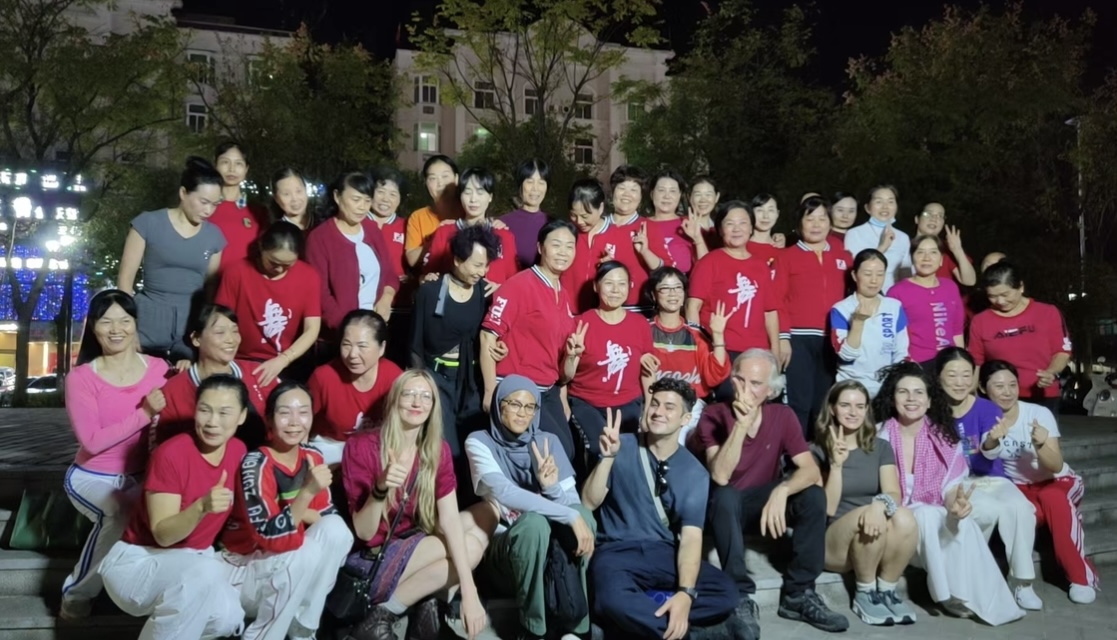
Last November, ten CODEPINK community members joined the very first community trip to China. Along the way, participants explored the innovation hub of Shenzhen, studied revolutionary history in Ruijin, visited villages transformed by poverty alleviation programs, gained insights into urban planning in Shanghai, and immersed themselves in the living traditions and ancient history of Beijing.
CODEPINK has for many years emphasized travel as a pathway to peace. We’ve launched community trips to Cuba, Venezuela, Iran, Gaza, and more. By experiencing another place firsthand, people gain a deeper understanding of its history, values, and aspirations, moving beyond the stereotypes and hostile narratives that fuel division. Cross-cultural exchange enables us to see one another’s humanity, to recognize our shared hopes for the future, and to build bridges of mutual respect. In an era when governments escalate tensions and prepare for conflict, people-to-people connections are essential to resisting the march toward war. This is especially critical now as the U.S. marches toward war on China, fueled by a suffocating quantity of war-driving propaganda meant to convince the public that China is our enemy.
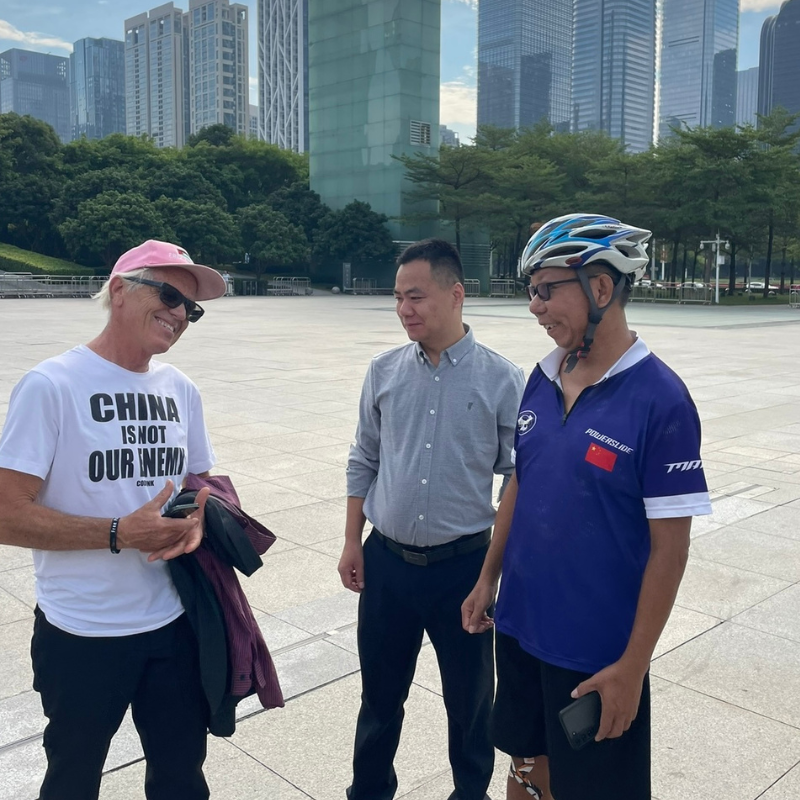
Through travel, dialogue, and friendship, we strive for a future founded on cooperation rather than confrontation. It is the people of the world who will ultimately lead the way to a peaceful future, not governments or institutions.
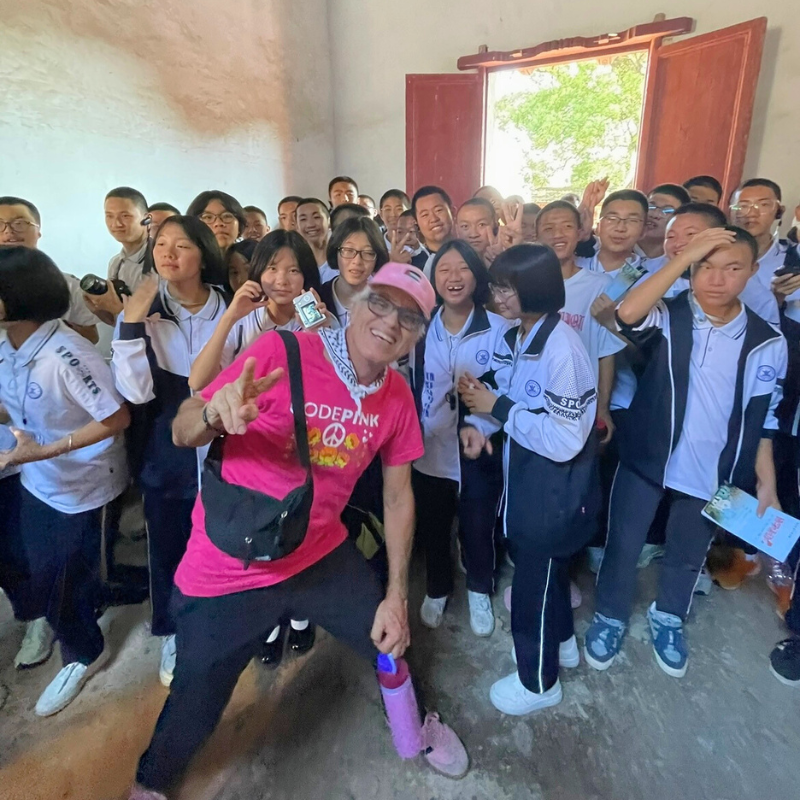
Collectively, some of the most transformative experiences on the trip came from interacting with local people and learning about China through the perspective of its citizens.
Here’s what the trip participants had to say about the trip…
Tighe
“I was amazed at how developed China was–so much construction and the buildings were massive and all new and clean, and everything was just astonishing. The minute I got to Shenzhen, I’m going, this is China? I never expected that at all because I’ve been all over Southeast Asia. Even though China is a developing country, it’s already surpassing us on so many levels that we should want to be friends with China and learn from China, and we should want to cooperate.”
Michael
“I was surprised by how profoundly affected I was, emotionally, by the part of the trip that involved the museums and reconstructed historical sites about the history of that decisive period in the history of China and the Communist Party when they founded the Soviet Republic in Ruijin, and then later on, that was where they began the Long March. I wouldn’t have necessarily thought that museums and reconstructed sites would have such a profound effect on me, but I was personally emotionally overwhelmed by the experience. And I was really surprised that I felt really connected to the history of the Chinese people in a very powerful way.
A key thing was Charlie, our guide. I can’t say too many positive things about Charlie—he was wonderful and philosophical and spiritual, and he shared some of his deepest personal feelings that gave us a window and maybe a bridge into the experiences of the people of China. Whenever there are people like that, it gives me hope. It's a great thing that such people exist.
When we were visiting the museums, Charlie said something that really stuck in my mind. He said, you know, I don’t like to glorify what happened in the war and in the revolution because so many people never came back. And when he said that, I think it triggered my emotions about the incredible cost of human life, and the sacrifices that were made by people with extraordinary vision of what could be done in the future, up against incredible obstacles. It’s a phenomenon of the human spirit, what China has done, and it makes me realize how precious what they’ve created is. People have given so much for it to exist, and that’s one of the reasons for us to defend it from our government’s aggression.
The other thing I’m processing is the fact that there were these people back in the 1920s who believed they could make incredible change in China, and that they did so with a tremendous amount of discipline and commitment and sacrifice. When we’re thinking about the obstacles we faced in the United States, which seem so insurmountable, I think it’s good to think of the fact that the insurmountable can be surmounted, and you shouldn’t be stopped by it.”
Julie
“There’s a much lower level of stress as you walk the streets. I live in San Diego, and there are a lot of homeless people all over the streets, and it’s really distressing, and you just shake your head because, what are we doing about it? So I feel like the fact that not only have they done something about it, but that the attitude is that if someone is on the streets, it’s not a failure of that person, it’s a failure of society, is such a different mentality and would obviously make a huge difference.”
Marcella
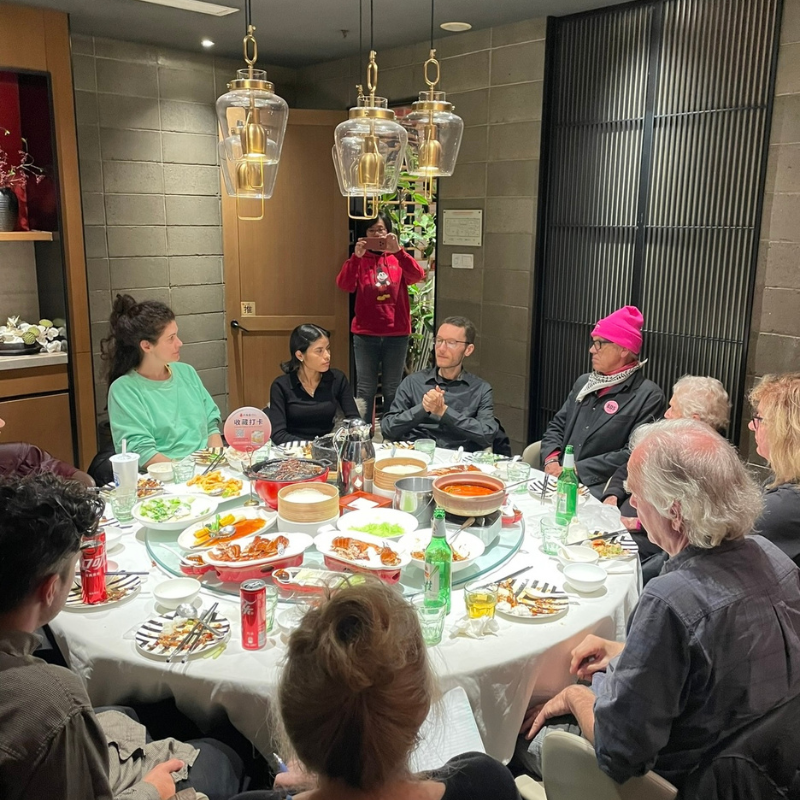
“I loved the communal aspect of all of our meals. I think as humans we’re just supposed to eat together. I think that’s very natural, and I loved that everything was family style, where you take a bit of this, a bit of that, and every meal they fed us so well. It was like a feast or a banquet.
The past year has been brutal for anybody who cares about Palestinian life and anybody who had any impression that the West cares deeply for human life, so for me, China was an antidote to cynicism. I said that because it shows not every country in the world is willing to fully cosign every genocide that’s actively going on.
The main thing I’m taking away from our travels is that a lot of the stuff we put up with and feel on a daily basis in the West in general, but especially in the United States, feels inevitable—like our economic decline, you know, the feeling that you’re coming in at the end of something and I feel that way a lot. Living here, things are kind of winding down, and you realize we are experiencing the choices that people make—we’re experiencing the result of human choice. China is a very different system, and they’ve made different choices concerning the economy, how they govern—it’s a different system. China proves that it’s not the end of history. These things should not be taken for granted. There are different economic and governmental systems that are serious alternatives that are delivering a better life for people, and we have to seriously grapple with that. I’m not saying you’re immediately going to say China is the best country in the world and we need to do everything they’re doing—no—but why shouldn’t we be looking at China and replicating what aspects we like?”
Megan
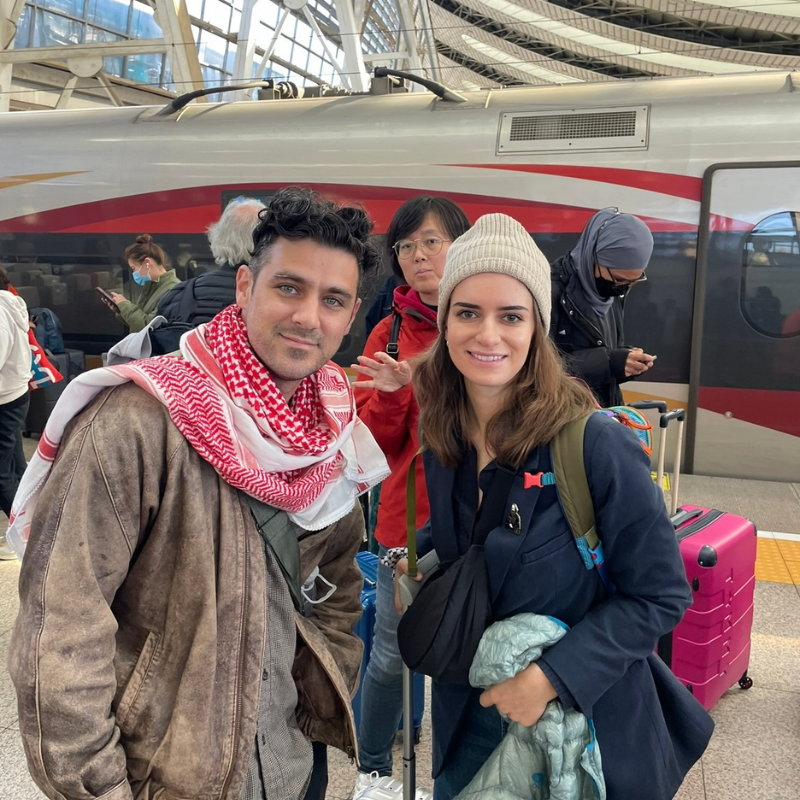
“There was this particular instance when we were in a smaller village outside of Guanzhou and this elder gentleman, the head of the village, had us sit around his dining room table where he had once hosted Xi Jinping ping and this was quite clearly the biggest and most meaningful event in his life—so much so that he froze his clock to that exact time to eternalized that memory. Photos of him and Xi sitting at the table were on the wall next to the table, and he told us about how his village underwent these changes as a result of the government's poverty reforms and how much it changed his life. It was really profound to see that sort of gratitude firsthand, to see how much the poverty alleviation programs affected not only a town but an individual. It's different to learn about it than it is to go to China and to feel it from the people, you know? So I'm grateful for that moment.”
Suzie
“It's kind of hard to put it into words, but I felt like when I was in China, the culture was like nothing that I'm used to, and it was hard to tell whether that was just because I hadn't been outside the US in a long time… But the culture in Hong Kong felt similar to the culture in the US, where people wanted to talk about culture war things and who I voted for—we went right after we found out that Trump won—and in China, it felt like the American culture war stuff was totally not there. I became really curious about how much of a bubble I live in. We took a tour of a village where an ethnic minority resides—two families have lived there for hundreds of years. They were huge families, and I couldn't understand. I had no compass for how that works. I realized outside of the US, ethnic minorities have long histories, and in the US, we have our own way of thinking about these things, but that's really just this weird 200-year-old bubble that is not a real thing necessarily.
Then also, you would see really cool technology—about 50% of the cars are all electric. Usually, when you see a feat like that, there’s all this advertising and tech language around it, but in China, there's really not any of that.
I also had this sneaking suspicion that Chinese culture does not have the idea that humans are inherently sinful. There were these feelings that would come to me about how the culture seemed more important than all the ideological learning I've done in the US. So now I'm still processing what my American bubble really is.
I keep saying to people, I felt so safe there. I lost my cell phone when we arrived at the Shanghai airport and realized when we had left—in London, we have an epidemic of phone snatching everywhere—so I didn’t have a lot of hope. But everyone was super helpful, and somebody we know in Shanghai told us not to worry, somebody’s going to turn it in, give it just a day or two. Well, lo and behold, someone the next day turned it in, and I went to the airport and collected it, and the guy at Lost and Found acted like this was the most normal thing in the world.”
Kurt
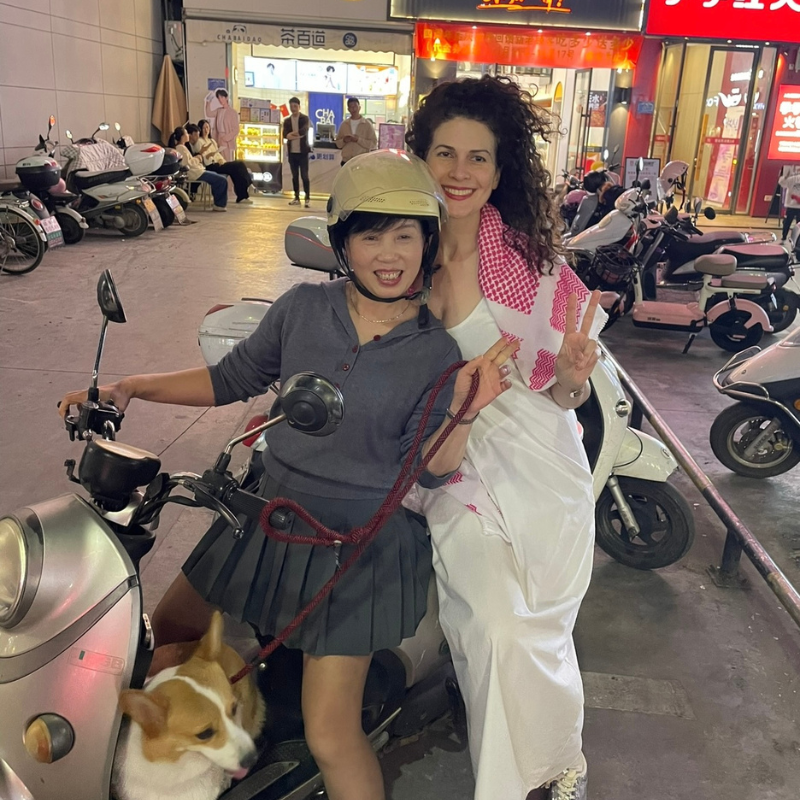
“I met a guy who was his first time going to the Great Wall for the first time, and his Uber driver just waited for him to experience it so he could take him back home afterward. There were these random acts of kindness that were just so beautiful, and it was this beautiful culture where everyone wants to help each other, and people are all dancing in the streets, and anybody can join. They are a formerly colonized people literally dancing in the streets, and they’re retired and they’re having a great time.”
Ethel
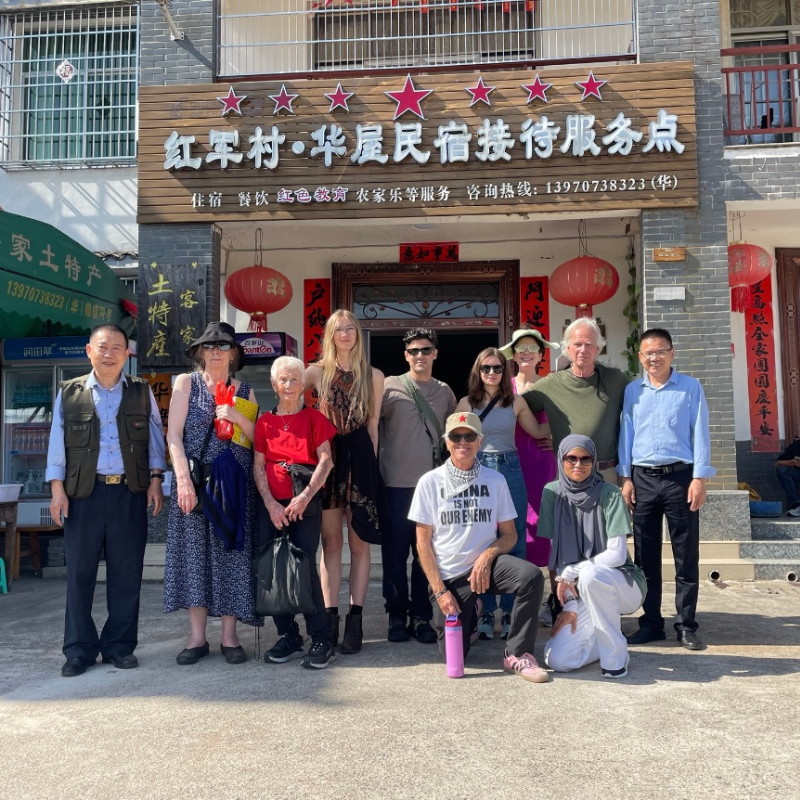
“You say something good about China and immediately somebody wants you to say something bad. People are so misled by our government and our media that it’s hard to get past that. So for me, I feel like I have to keep learning more and more history and really understand all the sides of China.”
Virginia
“Why do we want peace with China? We have nothing to fear, and we may learn something. The People's Republic of China demonstrates, through its accomplishments, the kind of society in which people can thrive. With the hard work and support of the Chinese people, and the foresight and planning of its leadership, China has lifted 850 million of its citizens out of poverty. It has built a breathtaking infrastructure, schools, transportation, universities, libraries, hospitals and medical clinics, dams, and clean energy systems. It focuses on common prosperity,
meeting people's needs and improving their lives, with an economic system that works well for them. It is committed to law-based governance and a whole-process democracy.
In spite of the majority not wanting the U.S. to have a military conflict with China, too many Americans hold conflicting or negative views on China. The method used to convince us that China is a threat is to constantly spread myths and brainwash us with malicious propaganda. The media gives them a platform to manufacture consent for more violence and war. And when we hear something over and over again, many people believe it. But we shouldn't permit the promotion of fear and hatred.
The U.S. maintains hundreds of military bases close to China's borders and in nearby seas, with long-range missiles pointing directly at China, with its population of 1.4 billion people. Let this sink in: What if China had hundreds of military bases off the coasts of the U.S.? It's time to open our minds to the truth about China and create a path toward peace by talking and working with others.”
Are you interested in traveling to China with CODEPINK community members? Fill out our China Travel Form to start receiving information on a 2026 CODEPINK Community Trip to China.
This article is part of our China Campaign Action Weeks! Take Action With Us NOW!
Megan Russell is CODEPINK’s China is Not Our Enemy Campaign Coordinator. She graduated from the London School of Economics with a Master’s Degree in Conflict Studies. Prior to that, she attended NYU where she studied Conflict, Culture, and International Law. Megan spent one year studying in Shanghai, and over eight years studying Chinese Mandarin. Her research focuses on the intersection between US-China affairs, peace-building, and international development.