


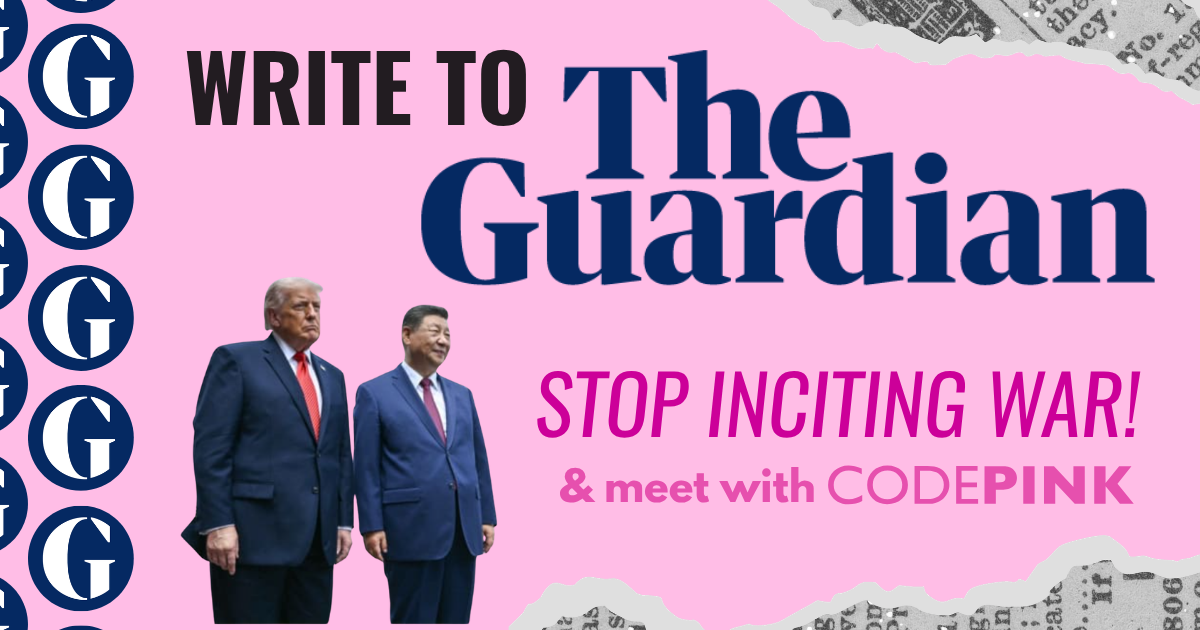
To the Writers and Editors of The Guardian,
We are writing to express our concern over your recent coverage of U.S.-China relations, particularly on reporting that frames China as a threat, while downplaying the central role the United States has played in escalating tensions over the past decade.
Your recent headline, “Xi warns Trump of ‘clashes and even conflicts’ with US over Taiwan” is deeply misleading, and clearly meant to stoke fear about war, all while painting China as the main cause. Framing China’s president Xi Jinping as the one who is threatening war is an intentional use of language that minimizes the U.S.’s role.
When President Xi Jinping speaks about the “Thucydides Trap,” he is warning against the assumption that war between major powers is inevitable and urging the United States to pursue diplomacy and coexistence rather than confrontation. Yet your reporting presented these comments in a way that implied China was advocating for conflict rather than cautioning against it.
At a time when the United States is dramatically expanding military spending, strengthening military alliances surrounding China, increasing naval deployments in the Asia-Pacific, and openly preparing for potential conflict, media outlets have a responsibility to provide context rather than reinforce fear-driven narratives.
Instead, much of Western media coverage continues to portray China primarily as an aggressor while minimizing the broader geopolitical and economic strategies driving U.S. policy. This includes conflicts and sanction campaigns directed at countries such as Iran and Venezuela, both of which are major economic partners and energy suppliers to China.
The consequences of this kind of reporting are serious. Media narratives shape public perception, political discourse, military spending priorities, and public support for confrontation. History has repeatedly shown how fear-based reporting can help manufacture consent for disastrous wars.
The Guardian has long presented itself as a publication committed to independent journalism and critical analysis. We are asking you to uphold those principles by:
- Avoiding sensationalized headlines that distort diplomatic statements.
- Providing accurate context about U.S. military expansion and strategic policy toward China.
- Publishing more reporting that critically examines the role of the United States in escalating tensions.
- Rejecting narratives that normalize or prepare the public for great-power war.
- Prioritizing evidence-based journalism over rhetoric designed to inflame fear and hostility.
We would also like to invite the editing staff of The Guardian to meet with CODEPINK to learn more about how the U.S. is escalating tensions against China.
The world is entering a multipolar era. Journalism should help the public understand this transition with nuance and honesty, not contribute to a climate of paranoia and fear.
We urge The Guardian to reflect seriously on the role media institutions play in shaping international tensions and to commit itself to more responsible, accurate, and credible coverage of China and U.S. foreign policy.
For peace and truth,