By Medea Benjamin
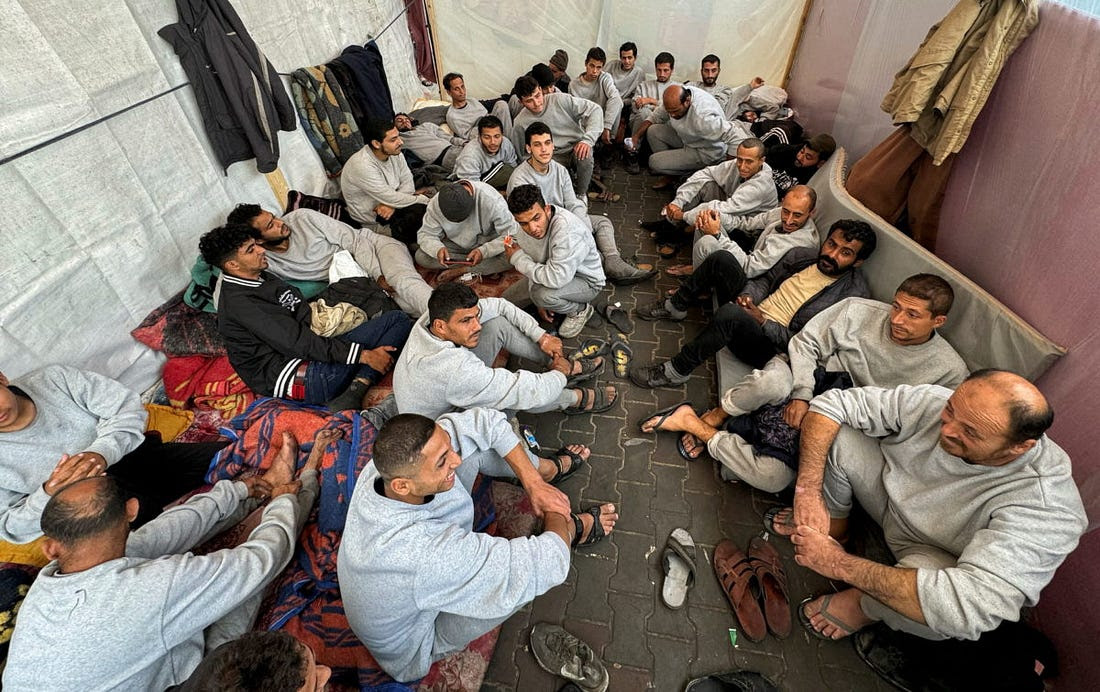
As part of the recent ceasefire agreement, Hamas released the remaining 20 living Israelis captured in October 2023. In return, Israel freed about 1,950 Palestinians. Yet while every Israeli was described in the media as a “hostage,” Palestinians were called “prisoners.” The distinction conceals a profound injustice: according to CNN, more than 1,700 of those released had been held without charge. These were not convicted criminals—they were hostages, imprisoned without trial to be traded later.
For every Israeli hostage freed, Israel released more than 85 Palestinians. But media coverage did not reflect that imbalance. Viewers saw endless footage of tearful Israeli families, while the Palestinian mothers waiting outside checkpoints for sons who had vanished into Israel’s prison system were barely shown. The imbalance of attention mirrors the imbalance of power—and it obscures the continuing crisis of thousands of Palestinians still behind bars.
In September 2023, Israel already held a record 5,000 Palestinians, including over 1,000 in “administrative detention,” meaning imprisonment without charge or trial. Two years later, that number had more than doubled. By mid-2025, human rights groups like B’Tselem and HaMoked reported that Israel was detaining over 10,000 Palestinians, including 3,600 administrative detainees, 3,200 awaiting trial, 2,600 classified as “unlawful combatants,” and roughly 1,400 convicted prisoners. In short, only about 13 percent had been sentenced—and even those sentences came from military courts with a 99 percent conviction rate.
Administrative detention is the cornerstone of this system. Under military orders, anyone—men, women, or children—can be held for renewable six-month terms based on secret evidence that neither they nor their lawyers are allowed to see. Judges can renew the orders indefinitely. Some detainees have spent years in prison without ever being charged. Among them are journalists, students, and elected officials. B’Tselem calls the practice “a routine, widespread means of oppression.” It is, in reality, a form of hostage-taking: people seized not for crimes committed but for their identity, activism, or usefulness in future negotiations.
Even those who are charged face a legal maze. Thousands are “remand detainees,” kept in custody for the entire duration of proceedings that often stretch on for years. For Israelis, pretrial detention is rare; for Palestinians, it is the rule. If a trial isn’t finished in 18 months, a military judge can extend the detention for another six months—and then another. Many defendants plead guilty simply to escape endless incarceration.
Others are held under the “unlawful combatants” law, which denies them both civilian and prisoner-of-war protections and allows indefinite detention without trial. Consider the high profite case of Dr. Hussam Abu Safiya, the pediatrician and director of Kamal Adwan Hospital in northern Gaza. In late December 2024, Israeli forces detained him; he has since been held without charge under Israel’s Unlawful Combatants Law. Despite global pressure, he was not released during the recent exchange.
Children are not spared Israel’s prisoner gulag. As of spring 2025, more than 300 Palestinian minors were in Israeli custody, over a third of them without charge. In the recent exchange, only six children were released.
Some of the children were arrested for stone-throwing or for social-media posts; others were simply caught up in raids. Defense for Children International reported that dozens had been beaten, denied counsel, or held in isolation. Amnesty International has documented “horrifying cases of torture and degrading treatment” of children.
This dual legal regime—civilian law for Jewish Israelis, military law for Palestinians—defines the apartheid structure of Israel’s rule. The ordinary vocabulary of justice collapses when a person can be snatched from their home, held without charge, and exchanged later as a bargaining chip. Israel’s October release of 1,950 Palestinians was not an act of generosity; it was a transaction. The arithmetic of the exchange exposes the asymmetry: Israel, the occupying power, had been holding more than 85 times as many Palestinians as Hamas held Israelis. Yet Western officials and journalists refuse to describe them as hostages. But by any legal measure—held without charge, denied counsel, and used for leverage—they are hostages.
Imprisonment has long been one of Israel’s main tools of control. Since 1967, more than a million Palestinians have been arrested—roughly one in five of all Palestinians living under occupation. Nearly every family has a relative who has been detained. Prisons are not simply punitive institutions; they are political instruments used to fragment Palestinian society and punish collective resistance. The United States, which provides Israel with at least $3.8 billion in annual military aid, is complicit in sustaining this system.
Even after the latest exchange, Israel still holds more than 10,000 Palestinians, including over 3,000 administrative detainees. Many are political activists, journalists, or ordinary civilians swept up in mass raids. Their continued captivity undermines any talk of peace or justice. When one side controls the cages, the courts, and even the language used to describe them, there can be no equality.
To call Israelis “hostages” and Palestinians “prisoners” is to accept that one people’s freedom matters more than another’s. The truth is simpler and harder: Israel continues to hold thousands of Palestinians as hostages, and the world continues to pretend they are not.
Medea Benjamin is a cofounder of both CODEPINK and the international human rights organization Global Exchange. She is the author of 11 books, including Drone Warfare: Killing by Remote Control, Kingdom of the Unjust: Behind the U.S.-Saudi Connection, Inside Iran: The Real History and Politics of the Islamic Republic of Iran and War in Ukraine: Making Sense of a Senseless Conflict, coauthored with Nicolas J.S. Davies. Her most recent book, coauthored with David Swanson, is NATO: What You Need to Know.