


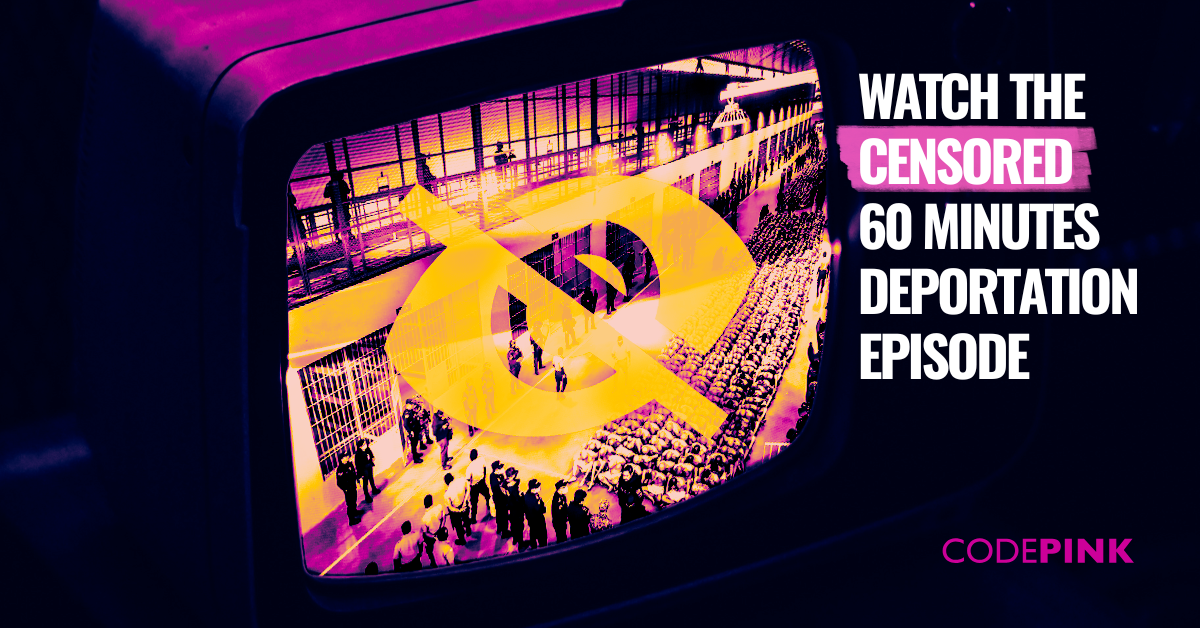
 A major 60 Minutes investigation exposing what happens to migrants after deportation was pulled at the last minute by CBS leadership. The episode documents how hundreds of migrants, most of them Venezuelans with no criminal records, were deported not to their home country, but to El Salvador’s CECOT prison, a site of mass incarceration, torture, and the suspension of due process.
The segment had already been screened multiple times and cleared by CBS attorneys. It wasn’t pulled for inaccuracy, it was pulled because it exposed state violence that powerful interests didn’t want broadcast.
This is a clear case of censorship. And it’s exactly why this story needs to be seen.
Sign up to receive a link to watch the full episode.
Background and Watch Party Resources
BACKGROUND
Who is Bari Weiss?
She’s the founder of the right-wing media company “The Free Press,” known for regurgitating Israeli propaganda and zionist talking points. She even calls herself a “Zionist fanatic.” In 2025, she was appointed editor-in-chief of CBS News, giving her authority over editorial decisions at one of the most influential news organizations in the United States, including what stories air, how they are framed, and which voices are considered credible.
What Is CECOT?
CECOT, the Centro de Confinamiento del Terrorismo, is a maximum-security prison in El Salvador built to hold tens of thousands of people. It is defined by: indefinite detention, extreme isolation, denial of due process, documented abuse and torture. People sent to CECOT have no meaningful access to legal recourse, family contact, or independent oversight. Human rights organizations have raised serious concerns about conditions inside the facility and the absence of accountability mechanisms.
U.S.–El Salvador Agreement
Under an agreement between the U.S. government and El Salvador, migrants, many of them Venezuelans with no criminal records, were deported directly into El Salvador’s prison system, including CECOT. The arrangement effectively allows the U.S. to outsource detention: people are removed from U.S. jurisdiction and placed into a carceral system with little transparency, oversight, or accountability.
HOW TO HOST A WATCH PARTY
A watch party can be simple and flexible.
Format options: In person (home, community space, campus room) or virtual (Zoom or similar platform)
Suggested timing: 15 minutes to watch the segment and 30 minutes for discussion
Tips for facilitation:
- Set shared expectations for respectful conversation
- Use 2–3 discussion questions to start
- Allow space for people to reflect before jumping to debate
- Connect the episode to local or personal experiences
Discussion questions:
- What does this episode reveal about what happens after deportation that is usually missing from media coverage?
- What information felt most disturbing, surprising, or intentionally minimized?
- Why do you think this episode was pulled, even though it had been legally cleared?
- Why do you think sanctions and U.S. foreign policy were not included in the episode?
- How do the dynamics in this episode connect to Palestine, Latin America, or other places where state violence is normalized through language?
- What responsibility do viewers have when an investigation is suppressed?
- How can collective actions like watch parties change how stories circulate and are understood?